
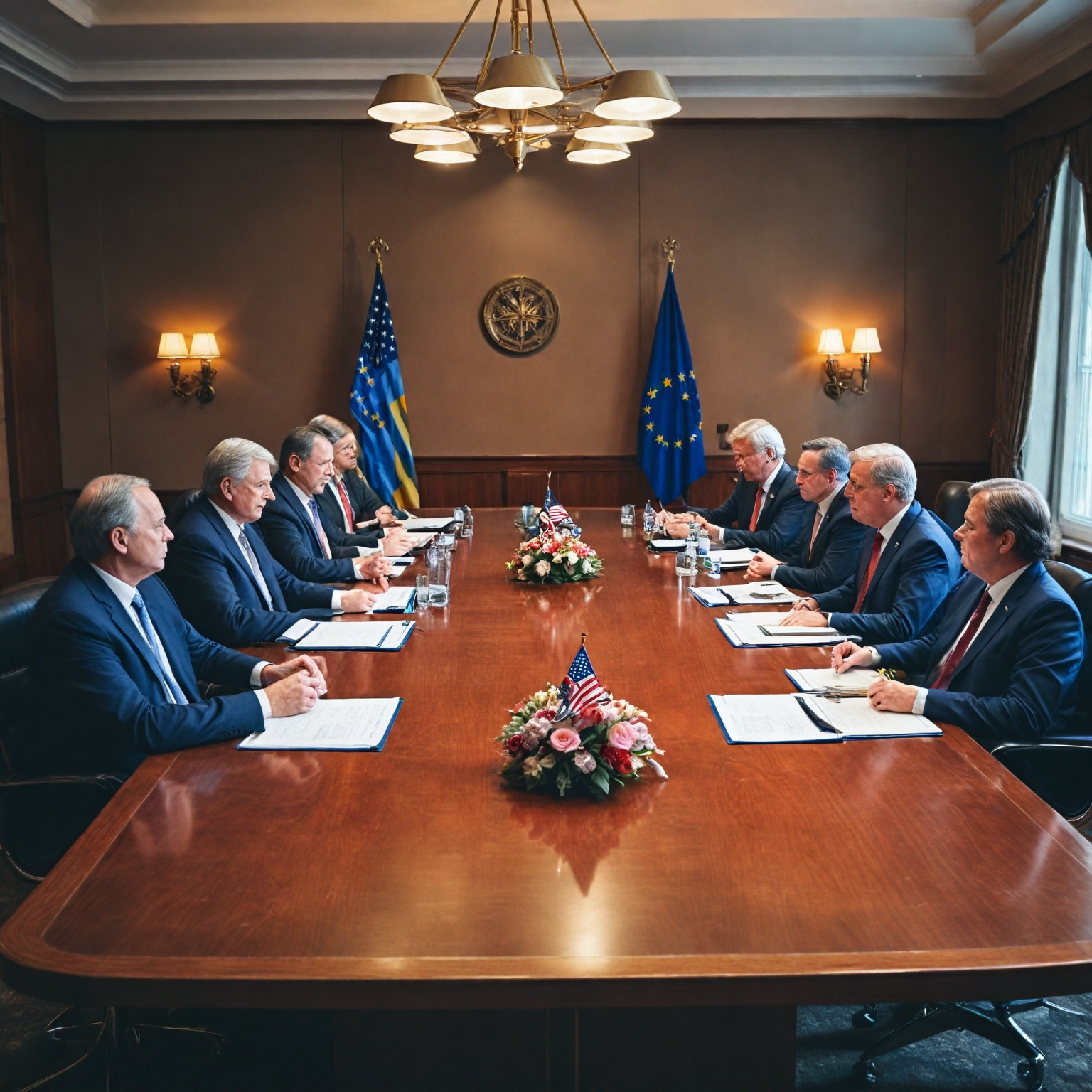
Highlights:
– The EU and the U.S. are engaged in high-stakes trade negotiations amid escalating tariffs, emphasizing the critical need for balanced and mutually beneficial trade relations.
– The tariffs have inflicted significant economic costs on European exporters, disrupting supply chains and increasing prices, underscoring the urgency to find negotiated solutions to prevent further damage to both economies.
– Politically, the EU's firm yet open stance towards dialogue and adherence to a rules-based international trading system contrasts with the U.S.'s emphasis on tariffs for restoring trade reciprocity, showcasing the complex dynamics at play in transatlantic trade relations.
Would you like to explore valuable solutions or insights regarding trade strategies during uncertain times? Feel free to discover our offerings for expert guidance and resources in navigating trade challenges efficiently.
Summary
The European Union (EU) is currently navigating heightened trade tensions with the United States amid the imposition of broad U.S. tariffs affecting key European exports. Initiated as part of a U.S. strategy to address trade imbalances and protect domestic industries, these tariffs—ranging from a baseline 10% on many goods to 25% on steel and aluminum—have targeted sectors including metals, pharmaceuticals, and semiconductors, provoking significant economic and political reactions from the EU. In response, the EU initially threatened retaliatory tariffs on American products worth billions of euros but agreed to a 90-day suspension of these measures to allow for negotiations aimed at resolving the dispute peacefully.
Despite ongoing diplomatic efforts, trade talks between the EU and the U.S. have so far failed to reach a comprehensive agreement, with disagreements persisting over tariff eliminations and non-tariff barriers. The EU has emphasized the need for balanced, mutually beneficial trade relations and focused on removing tariffs on industrial goods, while the U.S. insists on broader concessions, including in sensitive agricultural sectors. Meanwhile, the possibility of new U.S. tariffs targeting additional European industries raises concerns about further escalation, underscoring the fragile state of transatlantic economic ties.
Economically, the tariffs have imposed considerable costs on European exporters, particularly in sectors like chemicals, machinery, and equipment, which face tariff increases significantly above previous levels. These trade barriers have disrupted supply chains, increased prices, and threatened the competitiveness of EU companies in the U.S. market, leading to estimated export losses in the tens of billions of dollars. At the same time, the tariffs have been partially passed on to U.S. consumers, illustrating the broader global impact of the dispute. The EU continues to seek negotiated solutions to avoid protracted trade conflicts that could harm both economies.
Politically, the EU has balanced firmness with openness to dialogue, signaling readiness to impose countermeasures while prioritizing negotiation to avert a damaging trade war. European Commission leaders have emphasized a rules-based international trading system and have warned against unilateral actions that disrupt global commerce. Conversely, the U.S. government frames the tariffs as necessary to restore trade reciprocity and protect national security, reflecting deep-seated differences in trade policy approaches that complicate efforts to resolve the dispute. The evolving situation remains a focal point of transatlantic relations with significant implications for global trade stability.
Background
In response to escalating trade tensions, the United States implemented a baseline 10% tariff on a broad range of imports starting April 5, affecting several trading partners including the European Union (EU). These tariffs form part of a wider strategy linked to concerns over trade imbalances and protection of domestic industries, with significant focus on sectors such as metals, pharmaceuticals, and semiconductors. The imposition of these duties has reverberated globally, prompting adjustments in international business activities and scrutiny of how economies like China are responding to buffer potential shocks.
The EU, facing tariffs on its exports to the US, initially threatened retaliatory measures amounting to a 20–25% tariff on American goods, targeting products like poultry, grains, clothing, and metals. However, following diplomatic exchanges and the announcement by US President Donald Trump, the EU agreed to a 90-day suspension of these retaliatory tariffs to allow room for negotiations, signaling a temporary de-escalation in the trade conflict. This pause reflects efforts from both sides to find a compromise despite unresolved disputes, as discussions continue without a definitive agreement on tariff liberalization or trade concessions.
Trade imbalances remain a critical aspect of the tensions, with Eurostat data indicating that the EU held a €109 billion deficit in services trade with the US in 2023. The tariffs, if maintained, threaten to increase costs for European companies exporting to the US, potentially reducing their competitiveness in the American market and exacerbating economic frictions. The situation remains dynamic, with negotiations ongoing amid a backdrop of global financial leaders convening to address trade issues and seek pathways toward more stable international commerce.
Recent Developments
In response to the United States’ imposition of tariffs, the European Union (EU) has taken several measures while continuing to seek negotiated solutions to the escalating trade tensions. Following the announcement of U.S. tariffs of 25% on steel and aluminum imports and 20% tariffs on a broad range of other goods, the EU initially proposed retaliatory tariffs targeting approximately €21 billion worth of American products, including farm produce and goods from Republican states. However, European Commission President Ursula von der Leyen subsequently announced a 90-day suspension of these countermeasures to allow space for negotiations, emphasizing the EU’s preference for a zero-for-zero tariff agreement with the U.S. to avoid further harm to businesses and consumers on both sides.
Despite these efforts, trade talks between the EU and the U.S. have not yet yielded a compromise. The European Commission has highlighted the damaging impact of U.S. tariffs on the global economy and expressed a clear preference for mutually beneficial, negotiated outcomes. Nonetheless, ongoing discussions have been challenged by differing objectives: the U.S. aims for the elimination of both tariff and non-tariff barriers, including in sensitive agricultural sectors, while the EU has focused on removing tariffs on industrial goods and addressing conformity assessment issues. Technical talks on conformity assessment have progressed slightly, but formal negotiations stalled under the Trump Administration and have not yet advanced significantly.
In the meantime, the EU’s retaliatory tariffs have been paused, with the EU continuing to be subject to the baseline U.S. tariffs of 10% that came into effect earlier. The possibility of new U.S. tariffs targeting additional sectors such as pharmaceuticals and semiconductors is also being investigated, raising concerns about further escalation. At the same time, the EU has sought to strengthen trade relations globally to offset the impact of U.S. protectionist policies.
Economic Impact
The imposition of additional U.S. tariffs on European Union (EU) exports has had a significant economic impact, particularly on certain vulnerable sectors such as chemicals, machinery, and equipment. These industries face a notable increase in tariffs, with proposed blanket tariffs ranging from 10% to 20%, compared to the current average tariff level of around 2% on EU exports to the U.S. The chemicals sector is especially exposed due to its relatively low initial tariffs and a high degree of specialization in the U.S. market, which accounts for a substantial share of its exports. The cascading effects of these tariffs extend beyond direct exporters, influencing domestic productive sectors across EU Member States through supply chain interdependencies and intermediate goods and services purchases.
The retaliatory tariffs have also resulted in tangible export losses for the EU. A U.S. Department of Agriculture study estimated direct export losses at approximately $27 billion between 2018 and 2019. Additionally, tariffs on steel, aluminum, and goods from China have been largely passed through to U.S. consumer prices, illustrating the broad economic repercussions of these trade measures. Approximately 70% of EU exports to the U.S., worth €382 billion, have been affected by reciprocal tariffs introduced under the Trump administration, creating pressure on European exporters and complicating retaliation strategies.
EU officials have expressed a preference for negotiated outcomes with the U.S. to avoid escalating tariff disputes, emphasizing the importance of balanced and mutually beneficial trade relations. Despite these efforts, the EU faces a complex trade environment characterized by a balanced goods and services exchange with the U.S. — with a €48 billion goods surplus offset by a €109 billion services deficit in 2023 — indicating an overall trade gap of roughly €50 billion. This balance underscores the interconnectedness of transatlantic trade, where tariffs not only increase costs for EU exporters but may also reduce competitiveness and sales in the U.S. market.
The impact of tariffs is uneven across sectors, with some companies deeply integrated into the U.S. market confronting dual challenges: tariff-related cost increases and currency fluctuations that reduce euro-denominated profits. Certain sectors, such as agriculture and basic industrial commodities (soybeans, meat, tobacco, iron, steel, and aluminum), have been targeted by U.S. tariffs to protect domestic industries reliant on transatlantic trade. For example, the cosmetics industry in France and South Korea faces new 10% tariffs, prompting companies like e.l.f. to source products from non-EU countries such as China to maintain price competitiveness.
From the U.S. perspective, the tariffs serve multiple policy goals: addressing trade imbalances, incentivizing reshoring of manufacturing, and strengthening national security by rebuilding domestic industrial capacity. Persistent U.S. goods trade deficits with the EU and other trading partners, driven partly by asymmetric tariff rates and non-tariff barriers, have fueled these protectionist measures intended to restore reciprocity and safeguard critical supply chains.
In sum, the economic impact of the ongoing tariff tensions between the EU and the U.S. extends beyond direct export losses to broader supply chain effects, sector-specific vulnerabilities, and strategic realignments in sourcing and manufacturing, all occurring amidst complex negotiations aimed at achieving a stable and fair transatlantic trade relationship.
Political and Institutional Reactions
The European Union’s political and institutional response to the escalating tariff tensions with the United States has been marked by a mixture of firmness and openness to dialogue. European Commission President Ursula von der Leyen emphasized that the EU would negotiate “from a position of strength,” signaling readiness to counteract U.S. tariffs while maintaining the possibility of resolving the dispute through talks. She also announced a temporary suspension of the EU’s planned retaliatory tariffs on $21 billion worth of U.S. goods for 90 days, stating, “We want to give negotiations a chance,” even as U.S. tariffs on steel and aluminum remained in place. This pause was intended to create space for negotiations aimed at achieving a “balanced and mutually beneficial” trade agreement.
At the European Parliament level, key figures expressed caution regarding the impact of a tariff war. Bernd Lange, chair of the Parliament’s international trade committee, highlighted the principle of reciprocity, referencing Isaac Newton’s adage that every action provokes a reaction, thereby implying that any EU countermeasures would be a direct response to U.S. actions. Sophie Wilmès, vice-chair of the Parliament’s delegation for relations with the U.S., described tariffs as a last resort and stressed Europe’s capacity to defend its key sectors through dissuasion, retaliation, and protection measures.
Within the European Commission, there is recognition of the intertwined nature of the EU and U.S. economies. Some officials, including Luisa Santos from BusinessEurope, warned that escalating tariffs or regulatory measures could harm both sides due to economic interdependence. Nonetheless, analysts like Tobias Gehrke from the European Council on Foreign Relations noted that while the U.S. may have greater leverage, the EU possesses alternative tools such as digital levies on U.S. tech companies, regulatory constraints on financial services, and taxes on pharmaceutical exports that could be employed as countermeasures.
Institutionally, the European Union has demonstrated a commitment to uphold a rules-based international trading system. Von der Leyen, following discussions with Chinese Premier Li Qiang, underscored the responsibility of major global markets, including Europe and China, to support a fair and reformed trade environment, advocating for a negotiated resolution to avoid further escalation. The European Commission has maintained that the initial U.S. tariffs were “unjustified and damaging,” but also stated that EU countermeasures could be suspended if the U.S. agrees to a “fair and balanced negotiated outcome”.
The political stance within the EU thus balances retaliatory readiness with a strategic preference for negotiation. While member states nearly unanimously approved the imposition of 25% tariffs on selected U.S. goods as a form of retaliation, the Commission’s decision to hold off on implementing these tariffs reflects a calculated attempt to resolve tensions without exacerbating economic harm on either side. This approach aligns with the broader EU objective of avoiding a protracted trade war that could negatively affect global trade and economic stability.
In contrast, the Trump administration justified its tariffs as a response to longstanding trade imbalances and unfair trade practices by key U.S. partners, including the EU. It framed these tariffs as necessary for national security and economic sovereignty, invoking statutes such as the International Emergency Economic Powers Act and the Trade Act of 1974. The U.S. aims to eliminate both tariff and non-tariff barriers, with particular emphasis on sensitive sectors like agriculture, which poses challenges for EU negotiators.
Industry and Lobbying Responses
European industries have expressed deep concerns over the potential escalation of U.S. tariffs and the broader trade tensions between the EU and the United States. Several sectors are particularly vulnerable to the imposition of higher tariffs, with chemicals, machinery, and equipment industries standing out due to their significant export exposure to the U.S. market. For instance, the chemicals industry faces a relatively low initial tariff rate of about 1% but has a high degree of specialization and exports a larger proportion of its products to the U.S. compared to other sectors—26% of its exports in 2023 versus 19% overall—making it especially susceptible to tariff hikes ranging from 10% to 20%. The final impact on these industries depends not only on tariff levels but also on factors such as the elasticity of U.S. demand and the ability of European firms to shift sales to other markets or increase direct investment in the U.S.
In addition to export-focused industries, companies with predominantly domestic operations, including those in regulated sectors such as utilities, telecommunications, national financial services, and real estate, may be more insulated from the immediate effects of tariffs. However, these firms could still face indirect challenges from a global economic downturn and reduced consumer spending triggered by the trade conflict.
Major European multinational firms spanning various sectors also face significant headwinds. Companies like Compass Group (catering), Experian (credit reporting), Pearson (education publishing), RELX Plc (business analytics), InterContinental Hotels Group (hospitality), Rentokil Initial (pest control), and Smiths Group (technology and industrial) have all been identified as vulnerable due to their substantial exposure to the U.S. market. Pharmaceutical giants such as Denmark’s Novo Nordisk, Switzerland’s Roche, and France’s Sanofi, despite their large U.S. sales footprints, have so far remained exempt from the tariff regime.
Lobbying groups and industry representatives have voiced skepticism about the efficacy of using tariffs as leverage in trade negotiations. Luisa Santos, deputy director general at BusinessEurope, emphasized the intertwined nature of the U.S. and European economies, warning that measures like tariffs or restrictions on services could ultimately harm both sides. She argued that these measures “are not really leverage” because reciprocal actions would damage European interests as well.
European policymakers, meanwhile, have indicated readiness to respond assertively but cautiously. European Commission President Ursula von der Leyen signaled a stance of strength in negotiations, suggesting that the EU could impose countermeasures such as digital levies targeting Silicon Valley companies, regulatory restrictions on Wall Street, or taxes on U.S. pharmaceutical exports if pushed too far. The EU has already enacted counter-tariffs worth up to €26 billion on American goods in response to U.S. steel and aluminum tariffs, targeting products including boats, bourbon, and motorbikes. These responses illustrate a tit-for-tat dynamic, with the EU matching U.S. measures to protect its industries while keeping open the possibility of suspension should a fair and balanced agreement be reached.
Future Prospects and Implications
The future of EU-US trade relations remains uncertain amid ongoing tariff disputes and stalled negotiations. While the European Commission has expressed a clear preference for negotiated outcomes that are balanced and mutually beneficial, substantive progress has been limited. The Commission has sought to open negotiations focusing on the removal of tariffs on industrial goods and on conformity assessment agreements to address non-tariff barriers; however, these talks have not formally commenced under recent administrations, despite some technical discussions.
Retaliatory measures by the EU in response to U.S. tariffs are expected to continue evolving. The EU has prepared to impose tariffs targeting approximately €18 billion worth of U.S. goods, including a wide range of products such as boats, bourbon, and motorbikes, with the aim of matching the value of trade affected by new U.S. tariffs. The EU maintains that these countermeasures can be suspended if the U.S. agrees to a fair and balanced negotiated settlement.
The risk of
The content is provided by Avery Redwood, Anchor Press