Highlights:
– Donald Trump's first 100 days of his second presidential term were marked by unprecedented executive orders, vigorous policy changes, and polarizing actions, setting a confrontational tone that ignited strong reactions across the political spectrum.
– The visual transformation of the White House, including the introduction of extravagant decor and symbolic portraits, alongside the intense media coverage captured the essence of Trump's presidency, shaping public opinion and highlighting the controversies and divisions within his administration.
– Trump's administration's immigration policies and tariff implementations sparked intense debates, legal challenges, and public dissent, accentuating the deep political divisions and challenging traditional norms during his early tenure.
Summary
Donald Trump’s first 100 days in office, marking the initial phase of his second presidential term, were characterized by a swift and assertive exercise of executive power that set numerous records and generated widespread controversy. During this period, Trump signed an unprecedented number of executive orders—142 in total—surpassing previous presidential benchmarks and signaling an aggressive agenda focused on reshaping federal government operations, immigration enforcement, trade policies, and national security priorities. These rapid actions underscored his confrontational style, eliciting strong reactions from political allies, opponents, and the public alike.
Visually, Trump’s early presidency was distinguished by notable aesthetic and symbolic changes within the White House, particularly the Oval Office, where he introduced lavish gold decor and displayed portraits such as that of President James Polk to reflect his expansionist ambitions. Photographic coverage of this period played a critical role in shaping public perception, capturing moments that highlighted both his political messaging and the polarized responses to his administration, including viral images of male-only Republican meetings and protests like the Women’s March.
The administration’s immigration policies, especially enhanced border security and deportation efforts, as well as the imposition of broad tariffs, generated significant domestic and international debate. Legal challenges, public protests, and internal Republican dissent marked these initiatives as contentious and emblematic of the broader political divisions during Trump’s early tenure. Media coverage often focused on the dynamics of power within Washington, at times overshadowing the substantive policy implications of the administration’s actions.
Overall, Trump’s first 100 days left a lasting imprint on the presidency by breaking with traditional norms and emphasizing rapid, often unilateral decision-making that amplified partisan tensions and reshaped the visual and political landscape of the White House. The period remains a notable case study in the use of executive authority and the role of imagery in modern political communication.
Background
The first 100 days of a U.S. president’s term are often seen as a critical period that may foreshadow the priorities, achievements, and challenges of their administration. This milestone provides a useful benchmark for comparing a president’s early actions to those of predecessors and to their own campaign promises.
Donald Trump’s first 100 days were marked by a rapid and unprecedented exercise of presidential power, particularly within federal government agencies and departments. His approach included significant shifts in strategy and direct confrontations that left many observers—ranging from opponents to global counterparts and even some supporters—stunned by the intensity and speed of change.
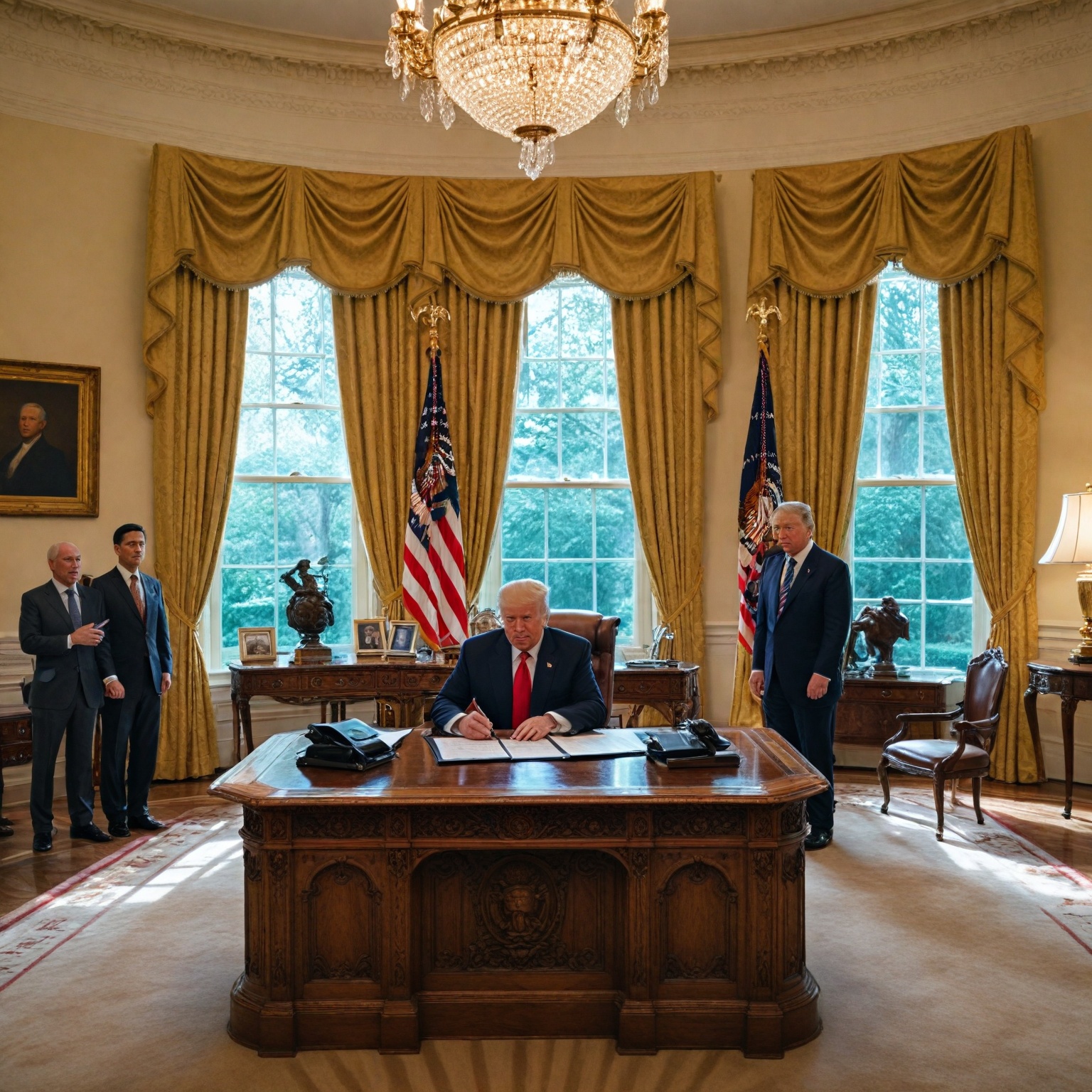
Beyond policy and governance, Trump also made distinctive aesthetic changes to the White House, particularly the Oval Office, introducing an abundance of gold decor such as gold-framed portraits, gold filigree on the fireplace, and gold vases on the mantle. These decorative choices reflected his personal style and preferences, distinguishing his administration’s physical space from that of his predecessors.
Visual representations of this period, including photographs and media clips, have been used to capture the atmosphere and symbolic elements of Trump’s early presidency. Notably, some media pieces juxtapose Trump’s presence in the Oval Office with other prominent figures, emphasizing different narratives of his initial time in office.
Key Events During the First 100 Days
President Donald Trump’s first 100 days in office were marked by a rapid and aggressive policy agenda, with several key events that highlighted his priorities and approach to governance. One of the most notable aspects was the sheer volume of executive orders he signed. In his first week alone, Trump issued 37 executive orders, and by late March, he had signed his 100th, surpassing the previous record set by Franklin D. Roosevelt, who signed 99 in the same timeframe. Overall, Trump signed a total of 142 executive orders by the 100-day mark.
These executive orders primarily focused on shrinking the federal government, reshaping foreign policy and defense, tightening immigration and border security, promoting energy and natural resources development, and imposing tariffs. Many of these actions sparked immediate controversy and legal challenges, particularly those related to immigration crackdowns and the military ban on transgender troops, which were temporarily blocked by courts as lawsuits proceeded.
Another significant event was Trump’s imposition of broad tariffs on imports, known as “Liberation Day” on April 2, when he announced 10% tariffs on all imports along with reciprocal tariffs on approximately 60 countries. This move caused market turmoil and prompted a 90-day pause on the tariffs as negotiations escalated, especially with China. Despite warnings from his own Republican allies about the economic risks, Trump remained steadfast in his support for tariffs as a negotiating tool.
In terms of immigration enforcement, Trump deployed hundreds of millions of dollars to enhance border security, including sending military elements to the U.S.-Mexico border. These efforts contributed to a reduction in border encounters, though some of the decline had already begun during the previous administration. His administration’s deportation policies led many potential migrants to reconsider attempts to enter the United States.
On the legislative front, Trump displayed a confrontational style, notably during an April meeting with House Republicans where he challenged ultraconservative members of the House Freedom Caucus who threatened to block a budget framework developed by Senate Republicans. This interaction illustrated his direct approach to managing congressional dynamics.
Culturally and symbolically, Trump’s first 100 days also included moments that underscored his political persona and priorities. For instance, a signed executive order restricting lobbying practices by appointees gained wide media attention and inspired viral internet memes. Additionally, Trump hung a portrait of President James Polk in the Oval Office, signaling his expansionist ambitions.
Public and political reactions were mixed, with notable protests during his address to Congress, including objections from Democratic lawmakers and members of the public. Meanwhile, the media’s focus on the White House power dynamics sometimes overshadowed broader coverage of the policy implications of Trump’s orders, with most news attention centered on his immigration policies and related court challenges.
Photographic Documentation
Photographs played a significant role in shaping the public perception of President Donald Trump during his first 100 days in office. Trump, who had long defined himself through images, found that photographs now had the power to define him in new and sometimes unexpected ways. One widely circulated image depicted Trump meeting with an all-male group of Republican lawmakers to discuss the health care bill. This photo attracted criticism for highlighting the absence of women in the discussion about policies that would affect women’s health, and quickly became a viral meme.
Inauguration-related photographs also sparked controversy. A National Parks Service photo of Trump’s inauguration was compared unfavorably with one of President Obama’s 2009 inauguration, leading to debates about crowd sizes and media portrayal. The day after the inauguration, the Women’s March was documented with demonstrators wearing distinctive “pussy hats” as a form of protest against the new administration.
The Oval Office, a symbolic backdrop for presidential power, featured heavily in photographic coverage. Trump was often captured signing executive orders, actions that began the dismantling of key Biden-era policies, including immigration crackdowns and withdrawal from international agreements. These images inspired viral memes, such as the @trumpdraws series, which parodied the frequent signing sessions. Another notable photograph featured Trump with El Salvador’s president Nayib Bukele in the Oval Office in 2025, underscoring the ongoing diplomatic use of photographic moments.
A striking painting based on a photograph of Trump with his fist raised and blood on his face following an assassination attempt became a symbol of defiance and resilience for the administration. This painting hung prominently in the White House, placed in direct visual competition with a portrait of former President Obama, and attracted attention from visitors and tours.
Social media and informal visual symbols also captured the spirit of the Trump administration’s early period. For example, an emoji trio representing a fist, the American flag, and flames was highlighted by a national security adviser as encapsulating the administration’s tough, nationalist, and disruptive style.
Themes and Narratives in Visual Coverage
Visual coverage of President Trump’s first 100 days in office captured a range of themes and narratives that reflected both the administration’s political style and the public’s response. One prominent theme was the portrayal of Trump’s confrontational and unconventional approach to governance. Images such as the emoji trio shared by National Security Adviser Michael Waltz—featuring a fist, an American flag, and flames—were seen as symbolic distillations of the administration’s spirit, combining macho posturing, nationalism, and a disruptive agenda. This visual shorthand encapsulated the aggressive tone that characterized many of Trump’s early moves.
Another key narrative focused on Trump’s blunt-force interactions with Congress, especially with conservative factions like the House Freedom Caucus. Photographs from meetings, such as those showing Trump in the Cabinet room asserting his authority over legislative partners, visually conveyed the tense power dynamics and the administration’s determination to push its agenda despite internal GOP divisions. These images helped communicate the sense of a White House willing to overwhelm opposition and break traditional bureaucratic norms.
The visual media also highlighted the administration’s symbolic gestures and rebranding efforts, such as the display of a painting of President James Polk in the Oval Office—a nod to territorial expansion—and the rechristening of the Gulf of Mexico as the “Gulf of America,” which illustrated Trump’s broader geopolitical ambitions and personal imprint on the presidency.
Public dissent and protest were another significant visual theme. Coverage of the widespread “Hands Off!” protests, where thousands gathered at state capitols and other public venues wearing pink and holding signs, illustrated the growing public demand for Democratic resistance to Trump’s policies. These images portrayed a highly engaged and mobilized citizenry expressing frustration, which extended even to Republican lawmakers facing pushback in their own districts.
Public and Media Reception
The media’s coverage of President Trump’s first 100 days in office was characterized by a strong focus on the Washington power dynamics, often highlighting who was gaining or losing influence within the political landscape. However, this emphasis largely catered to political enthusiasts and seemed distant from the everyday concerns of most Americans. A report from the Harvard Kennedy School’s Shorenstein Center revealed that except for Trump’s immigration orders—particularly those challenged in courts—the press paid relatively little attention to other executive actions during this period.
Trump’s inauguration on January 20 drew hundreds of thousands of attendees, though the exact crowd size became a contentious topic of debate in the media and among politicians, often compared to previous ceremonies. The following day, the National Mall saw demonstrators taking over from Trump supporters, notably during the Women’s March where many participants wore pink “pussy hats” as a symbol of protest. This visual dissent was part of a broader public pushback, with more than 1,400 “Hands Off!” protests occurring nationwide in April at various government buildings and public spaces, reflecting widespread opposition not only from Democrats but also from frustrated Republican constituents during town hall meetings.
Inside Washington, President Trump’s confrontational style was evident in interactions with legislative partners. For example, a meeting with House Republicans in April showcased tensions with the ultraconservative House Freedom Caucus, who opposed a Senate GOP budget framework, stalling progress on key agenda items.
Internationally, Trump’s policies and shifts in U.S. global strategy prompted concern among traditional allies. Reuters reported that multiple government officials, diplomats, and analysts voiced worries about potential long-term damage to U.S. relations amid decisions such as launching investigations into imports that might threaten national security, and ongoing trade tensions with China following tariff impositions and retaliatory export suspensions. The White House, however, maintained that these actions were aimed at restoring peace and prosperity through swift and decisive leadership.
Impact and Legacy
Donald Trump’s first 100 days in his second term were marked by a series of rapid and often destabilizing changes that left a significant imprint on both the presidency and the broader political landscape. This period was characterized by aggressive power grabs, strategic shifts, and direct attacks on various institutions and initiatives, signaling a departure from traditional presidential norms and a challenge to established bureaucratic processes.
One notable aspect of this era was Trump’s confrontational stance toward inclusivity programs within the federal government. In the aftermath of a tragic crash near Washington, DC, Trump controversially blamed diversity and inclusion initiatives at the Federal Aviation Agency for hiring individuals with intellectual disabilities as air traffic controllers—a claim made without evidence. This episode underscored his broader attack on diversity efforts proliferating across government and corporate sectors.
The symbolic transformations within the White House also reflected Trump’s imprint on the office. His affinity for gold was manifested in the extensive use of gold-framed portraits and decorative elements throughout the Oval Office, signaling a personalized redecoration that diverged from traditional presidential aesthetics. Additionally, Trump’s cultivation of a combative public image was reinforced by prominent displays, including a large painting of himself with a bloodied face from an assassination attempt, positioned in direct visual competition with a portrait of Barack Obama.
While Trump’s first 100 days set multiple records in terms of executive actions and political maneuvering, they also highlighted the fragility and volatility of relying solely on rapid presidential initiatives to secure lasting policy achievements. The intense media focus on the Washington power dynamics often overshadowed broader coverage of Trump’s executive orders, leaving much of the public disconnected from the full scope of his early term’s impacts.
The content is provided by Jordan Fields, Anchor Press