Ivy League Professor Fights AI Cheating with In-Person Finals—But Scores Plummet by 50%!
Understanding the AI Challenge to Academic Integrity
The widespread availability of generative AI tools has fundamentally altered the landscape of academic integrity, presenting new challenges for universities that traditionally relied on honor codes and established plagiarism detection methods. This technological shift has rendered many conventional enforcement mechanisms less effective, leading to a noticeable increase in detected cheating cases across educational institutions. For instance, recent data from the UK indicates a more than threefold increase in students caught using AI for academic dishonesty, while surveys at Ivy League institutions like Princeton show a significant percentage of students admitting to AI-assisted cheating.
This rise in AI misuse not only compromises individual student integrity but also erodes the crucial trust between students and educators, raising concerns about the long-term value and credibility of higher education degrees. Many students, often driven by intense competition and demanding schedules, perceive AI as a convenient shortcut, potentially substituting genuine learning for quick results. Consequently, institutions are compelled to re-evaluate their assessment strategies and integrity policies to safeguard the authenticity of academic achievement.
Case Study: Brown University’s Response to AI Cheating
At Brown University, economics professor Roberto Serrano encountered a significant AI-assisted cheating incident in his mathematical economics course, highlighting the immediate impact of these new tools. After administering a take-home midterm exam, a common practice in many Ivy League schools, Serrano observed an unusually high number of perfect scores, with 40 out of 86 students achieving 100%. This anomaly immediately raised suspicions about widespread AI tool usage to complete the exam dishonestly.
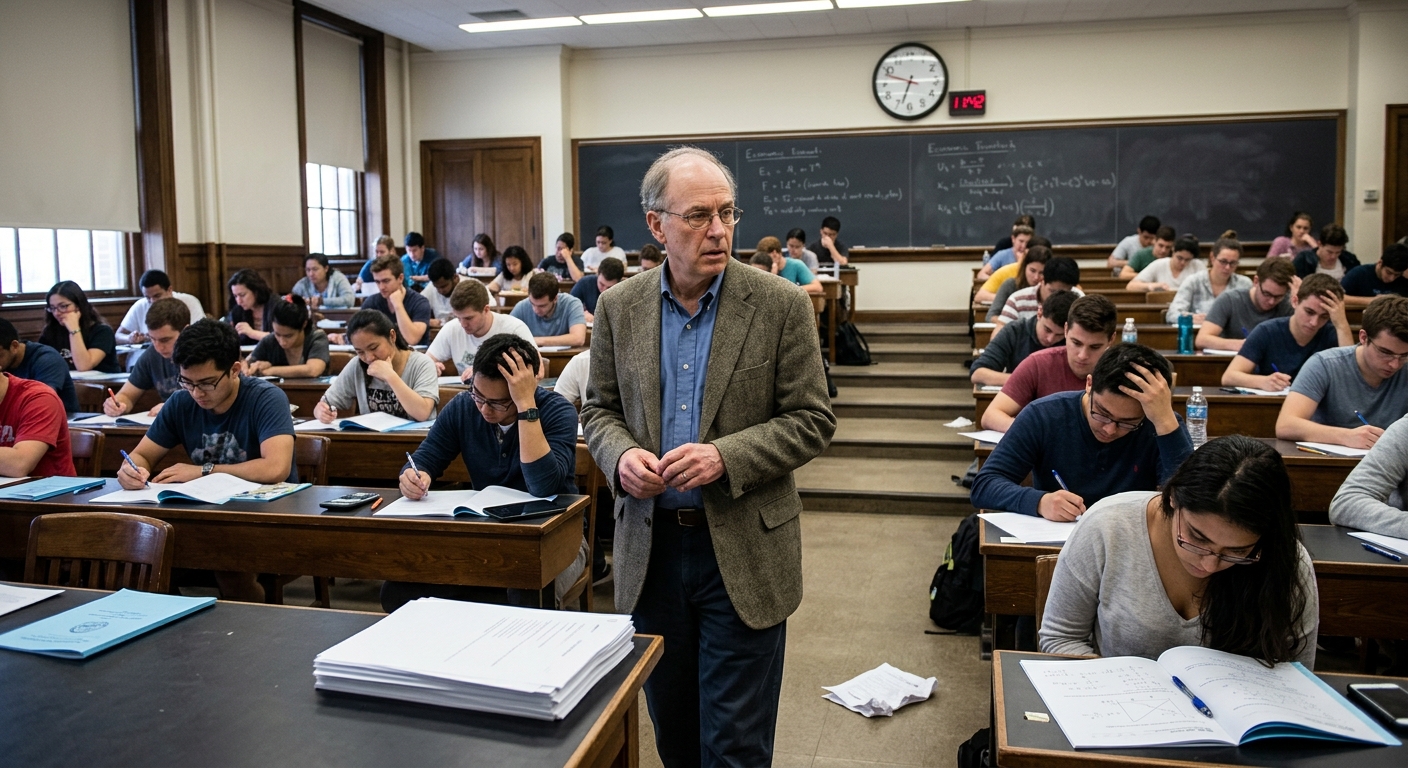
Despite his prominent faculty position, Serrano initially faced a muted response from the university administration when he escalated his concerns, only receiving a more serious acknowledgment after involving the Academic Code Committee. This experience underscored the institutional friction in addressing novel forms of academic misconduct. To counteract the suspected cheating and re-establish academic rigor, Serrano made a decisive shift for the final exam, moving it to an in-person, proctored format and stipulating that if the final exam’s grade distribution diverged significantly from the midterm’s, the midterm would be nullified.
The results of the in-person final exam were stark: the average score plummeted from 96 on the midterm to 48, a dramatic 50% decrease. Furthermore, 27 students, including 22 who had previously scored perfectly on the midterm, did not attend the final exam, with many opting to drop the course entirely between the two assessments. This outcome strongly suggested a lack of confidence in their ability to perform without AI assistance, providing a clear demonstration of the impact of unsupervised versus supervised examination environments on student performance and integrity.
Rethinking Assessment Methods in the AI Era
The incident at Brown University, alongside broader trends, compels a critical re-evaluation of traditional examination methods and their suitability in an AI-permeated academic environment. While conventional exams are valued for their efficiency and objectivity, concerns persist regarding their equity, as they may inadvertently assess test-taking skills more than genuine learning outcomes, potentially disadvantaging students from diverse backgrounds. This tension between standardization and fairness becomes even more pronounced when considering the ease with which AI can circumvent traditional assessment security.
Consequently, there is growing advocacy for more holistic and authentic assessment methods, such as continuous assessment or project-based work, which aim to cultivate a broader range of skills including professionalism, ethics, and critical thinking. These approaches often better reflect real-world professional demands and can prepare students for complex challenges beyond the classroom, including the ethical integration of technology. However, the transition to such alternative assessments introduces its own complexities, particularly regarding the potential for AI misuse in open-book or take-home formats.
The debate also extends to the environment in which assessments are conducted, with remote modalities showing promise for certain populations, such as those who experience heightened anxiety in traditional testing settings. For example, remote evaluations in clinical settings have demonstrated that some individuals perform more accurately and reliably in familiar, low-stress home environments. This suggests that the context and environment of an assessment are significant factors in both student performance and the validity of the evaluation, requiring careful consideration when designing assessment frameworks that balance fairness, validity, and educational goals against the backdrop of evolving technological threats.
Institutional Adaptations and Policy Shifts
The escalating challenge of AI-assisted cheating has spurred diverse institutional reactions across universities, highlighting a fundamental tension between long-standing honor codes and the urgent need for more proactive integrity measures. Historically, many prestigious institutions, particularly Ivy League schools, have relied heavily on student honor systems rather than preventive monitoring to deter academic dishonesty. However, the widespread accessibility of generative AI tools, especially on personal devices, has significantly complicated the enforcement of these honor codes, making violations harder to detect and report.
In response, some institutions are adopting more stringent policies to counteract AI cheating, signaling a significant shift from traditional reliance on student self-governance. For example, Princeton University, after more than a century, reinstated in-person proctoring for exams, a move driven by faculty and student concerns about the ease of AI-enabled cheating and the difficulties in anonymous reporting. This unanimous decision by the administration represents one of the most substantial changes to the school’s honor system, underscoring the severity of the problem and the recognition that honor codes alone may no longer suffice.
Beyond exam proctoring, other universities are adjusting their practices more broadly; for instance, Duke University ceased using numerical ratings for student essays in admissions to reduce incentives for AI-assisted work. These institutional responses reflect a growing consensus that AI poses unique challenges to maintaining academic integrity, necessitating a re-evaluation of foundational principles and the implementation of robust, adaptable strategies. The collective effort across higher education aims to reaffirm the value of human thought and academic honesty in the face of rapid technological disruption.
Navigating the Future of Academic Evaluation
The pervasive challenges posed by AI-assisted cheating necessitate a comprehensive re-evaluation of assessment practices across all levels of higher education, extending beyond individual institutional responses. The rapid adoption of generative AI among students, with some reports indicating nearly universal usage for assessments in certain regions, underscores a profound transformation in how academic work is approached and evaluated. This shift demands not only technological countermeasures but also a fundamental pedagogical realignment to effectively uphold academic integrity.
Experts increasingly argue that relying solely on AI-detection tools is insufficient to mitigate the risks, advocating instead for a fundamental shift towards validity-driven and authenticity-focused assessment practices. This approach emphasizes more holistic and authentic forms of evaluation that genuinely reflect student learning and capabilities, potentially allowing for the ethical integration of support systems, whether human or AI-assisted. While in-person, proctored exams remain a reliable method for ensuring independent student effort, they are no longer a standalone solution given the increasing sophistication of AI technologies.
As AI tools become more accessible and powerful, educators and policymakers must conduct thorough scenario analyses to understand the long-term impacts of AI cheating on university applications, funding, and partnerships, developing strategies that are both sustainable and equitable. The future of higher education will likely depend on a balanced approach that effectively mitigates AI misuse while simultaneously harnessing its potential to enrich learning and evaluation processes. This evolution requires a commitment to integrating AI literacy into curricula, fostering an environment where AI serves as an aid to deeper learning rather than a shortcut around it, thereby preserving academic standards and student well-being.
The content is provided by Sierra Knightley, Anchor Press