Unlocking the Future: How SpaceXs Starfall is Revolutionizing Global Cargo Delivery from Orbit
Summary
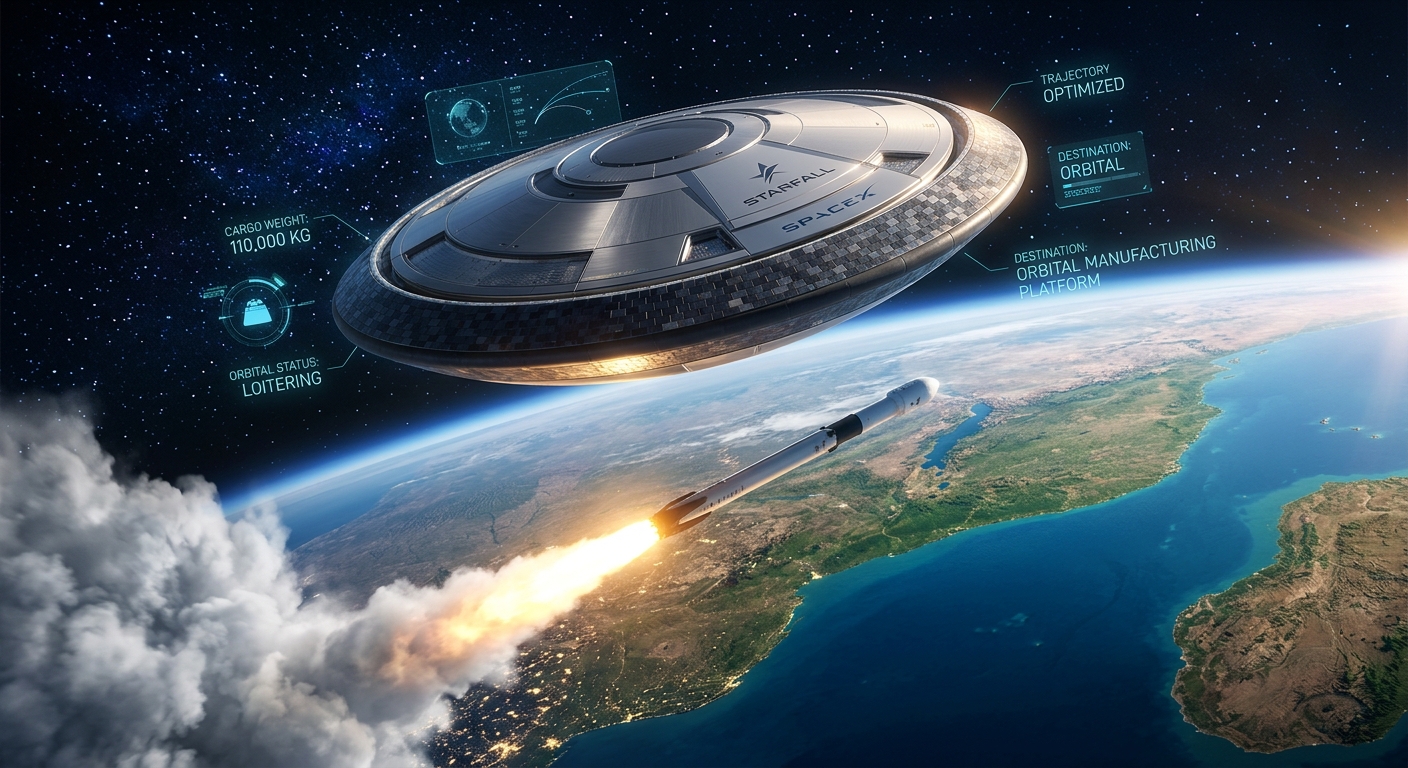
Starfall is an innovative space program developed by SpaceX that aims to revolutionize global cargo delivery and in-orbit manufacturing by leveraging unique low Earth orbit conditions. Unlike traditional spacecraft focused on exploration or satellite deployment, Starfall utilizes specially designed disk-shaped capsules—resembling giant hockey pucks—to serve as autonomous platforms for microgravity manufacturing and rapid point-to-point cargo transport on Earth. These capsules can carry up to 1,000 kilograms of payload and are engineered for frequent reusability, with advanced thermal protection systems enabling safe reentry and ocean recovery.
Building on SpaceX’s expertise with the Dragon spacecraft, Starfall represents a major technological leap by integrating manufacturing capabilities with space logistics. Deployed initially via Falcon 9 rockets and planned for future launches aboard the heavy-lift Starship vehicle, the capsules offer strategic advantages such as loitering in orbit for on-demand cargo delivery and the ability to facilitate critical shipments for military, disaster relief, and commercial purposes worldwide. The program’s modular, disk-shaped design optimizes thermal and aerodynamic performance during atmospheric reentry, marking a significant departure from traditional cone-shaped capsules and enabling faster turnaround times between missions.
Starfall’s development also underscores SpaceX’s evolving business strategy, positioning the company to capitalize on an estimated $28.5 trillion market spanning in-orbit manufacturing, space-based logistics, and Earth-to-Earth rocket cargo delivery. By combining launch, manufacturing, and return capabilities within a unified system, SpaceX aims to establish a self-sustaining commercial space economy, competing directly with existing manufacturing startups and advancing new markets such as space tourism, extraterrestrial mining, and advanced materials production.
However, the program faces technical, regulatory, and market challenges. The unique design and operational concepts require robust thermal protection and precise reentry control, while environmental assessments and FAA approvals are critical to ensure safety and sustainability. Additionally, the ambitious market projections and financial strategies expose SpaceX to scrutiny and uncertainties inherent in pioneering new aerospace services. Despite these hurdles, Starfall’s initial prototype test flights in 2026 mark a pivotal step toward transforming global cargo delivery and orbital manufacturing capabilities.
Background
SpaceX’s Starfall program represents an innovative leap in leveraging space for both manufacturing and cargo delivery purposes. Unlike traditional space missions focused primarily on exploration or satellite deployment, Starfall aims to harness the unique conditions of microgravity and vacuum in low-Earth orbit to enable manufacturing processes that are difficult or impossible to replicate on Earth. The program involves specially designed capsules, shaped like giant hockey pucks, which serve as platforms for in-space production as well as vehicles for rapid point-to-point cargo delivery around the globe.
The development of Starfall builds upon SpaceX’s existing expertise in cargo return missions, notably the Dragon spacecraft, which transports pressurized and unpressurized cargo between Earth and the International Space Station with safe parachute splashdowns. Starfall extends these capabilities with a novel form factor and broader applications, aiming to establish a self-sustaining commercial manufacturing economy in space. According to Federal Aviation Administration (FAA) filings, the capsules could act as a “proliferated successor” to the International Space Station by providing loitering capabilities in orbit and safe return services at scale.
The program also emphasizes strategic and logistical advantages. With Starship’s heavy-lift capacity of up to 100 tonnes, SpaceX could deploy Starfall capsules into orbit routinely alongside other missions, reducing incremental launch costs. The capsules are intended not only for manufacturing but also for rapid cargo deployment anywhere on Earth via space, with potential recovery zones located thousands of miles offshore to facilitate safe splashdowns and retrieval. This capability is particularly attractive for military applications and disaster relief efforts, as it would reduce dependence on terrestrial supply depots by maintaining cargo in orbit for immediate delivery on command.
Although SpaceX has been notably silent about Starfall’s detailed specifications and timeline, public documents and investor presentations hint at its transformative potential. A graphic shown during an investor roadshow depicted a satellite housing multiple Starfall capsules labeled as “in-orbit manufacturing,” indicating the company’s strategic focus on building a versatile space-based logistics and manufacturing infrastructure. Overall, Starfall is positioned as a pioneering program that could revolutionize global cargo delivery and create new commercial opportunities in orbital manufacturing.
Development of the Capsule System
SpaceX’s Starfall capsule system represents a significant advancement in spacecraft design aimed at revolutionizing global cargo delivery and in-space manufacturing. The capsules are uniquely shaped like giant hockey pucks, a disk-like form that optimizes structural integrity and payload capacity by spreading aerodynamic and thermal loads across a broader surface area rather than concentrating them in a conical shape. This innovative design allows the capsule to carry up to 1,000 kilograms (2,205 pounds) of payload within an internal volume measuring approximately 2.5 by 1.5 by 0.5 meters (8.2 by 4.9 by 1.6 feet), while maintaining a total launch mass near 3,100 kilograms.
Development efforts have focused on creating a spacecraft that serves multiple commercial purposes, including autonomous platforms for microgravity manufacturing—such as pharmaceutical processing, advanced protein crystallization, and semiconductor production—as well as enabling rapid point-to-point cargo delivery on Earth through suborbital ballistic trajectories. The capsule is designed for deployment atop SpaceX’s Falcon 9 rocket initially, with future launches planned using the larger Starship vehicle, which can carry multiple Starfall units in a single mission, increasing operational flexibility and cost-effectiveness.
To protect the capsule during reentry, SpaceX employs advanced thermal protection systems (TPS) that utilize a 3-D woven architecture, allowing for integrally connected layers within a woven preform. This manufacturing process enhances the uniformity and performance of the heat shield, tailoring thermal conductivity and ablation characteristics to meet the demanding conditions of atmospheric reentry. Recovery operations are planned in designated splashdown zones typically located approximately 1,300 kilometers west of the U.S. or Mexico, where recovery teams retrieve the capsule along with its heat shield and parachutes for refurbishment and reuse.
The Starfall program reached a major milestone on June 23, 2026, when SpaceX successfully demonstrated the capsule on its first mission launched from Cape Canaveral. This event coincided with the company’s first public bond offering, underscoring the strategic importance of Starfall in SpaceX’s broader commercial ambitions to create a self-sustaining in-space manufacturing market and capitalize on rapid cargo delivery services worldwide. The program’s development reflects SpaceX’s ongoing commitment to revolutionizing space technology, in line with its founding mission to enable human life beyond Earth.
Technical Specifications and Design Features
Starfall is a conically inspired, disk-shaped reentry capsule designed by SpaceX to significantly enhance cargo return capabilities from low Earth orbit. Measuring approximately 3 meters (10 feet) in diameter and 0.75 meters (2.5 feet) thick, the capsule has a mass of about 2.1 tonnes and can carry up to 1,000 kilograms of payload internally within a 2.5-by-1.5-by-0.5-meter bay. This payload capacity represents a substantial increase compared to current reentry vehicles, offering at least a 30-fold improvement in single-flight return mass over existing capsules.
The structural design of Starfall features a top half constructed from aluminum combined with specialized thermal protection materials, while the bottom half is composed of carbon fiber wrapped in a high-performance thermal protective layer. This configuration optimizes thermal resistance during atmospheric reentry and balances weight and strength. Notably, Starfall’s thermal protection system (TPS) employs advanced materials and manufacturing techniques, including automated 3-D weaving processes that produce integrally connected woven layers, enhancing uniformity and thermal performance. This TPS design allows tailored weave architectures that precisely control local thermal conductivity and ablation characteristics, facilitating use on both sharp and blunt leading edge geometries.
Unlike traditional capsules, Starfall does not have an onboard chemical propulsion system for deorbit maneuvers. Instead, it relies on its launch vehicle or an external kick-stage to initiate reentry trajectories. For orientation and attitude control during descent, Starfall uses cold-gas thrusters powered by compressed nitrogen tanks housed within the heat shield assembly. This arrangement enables precise attitude adjustments without the complexity and mass of a dedicated propulsion system. The heat shield, weighing approximately 700 kilograms, is mechanically jettisoned shortly before splashdown, allowing recovery vessels to retrieve all spacecraft components from the ocean.
To protect sensitive cargo, the capsule’s interior is pressurized with nitrogen or an inert gas, maintaining a stable environment during reentry and landing operations. Starfall’s design emphasizes modularity and rapid reuse; its thermal protection materials benefit from manufacturing and testing techniques pioneered by facilities such as the Johnson Space Center’s Thermal Protection System Facility (TPSF), which enables fabrication, heat cleaning, sintering, and repair of TPS elements.
Starfall’s disk-shaped architecture distributes aerodynamic and thermal loads across a broader surface area compared to traditional conical capsules, which often dedicate significant structural mass to maintaining shape under reentry stresses. This shape not only enhances payload volume efficiency but also supports the capsule’s intended high-cadence return missions, particularly for manufacturing products produced in microgravity environments, such as pharmaceutical crystals and semiconductor wafers. The capsule’s lack of propulsion and simplified thermal protection system also reduce landing infrastructure requirements, facilitating rapid recovery and turnaround.
Flight Profile and Mission Operations
The Starfall mission employs a Falcon 9 rocket launched from Space Launch Complex 40 (SLC-40) with a precise one-hour launch window beginning at 6:43 a.m. EDT (10:43 UTC), targeting a splashdown zone approximately 1,300 kilometers off the coasts of California and Mexico in the Pacific Ocean. The mission’s trajectory is designed to place the Starfall capsule either into orbit or on a direct suborbital ballistic path, depending on the flight profile for the particular test.
Once deployed, the disk-shaped Starfall capsule, measuring 0.75 meters tall and 3.1 meters in diameter, relies on cold-gas attitude control thrusters to maintain orientation during its orbital or suborbital phase; however, it lacks any propulsion system for autonomous deorbiting. The vehicle’s design emphasizes a compact and wide geometry, which enhances reentry stability and allows for rapid turnaround between missions, differing markedly from traditional cone-shaped capsules such as SpaceX’s Dragon.
During reentry, the capsule endures extreme thermal environments, necessitating robust thermal protection systems (TPS) to ensure structural integrity and payload safety. Approximately 700 kilograms of heat shield material are mechanically jettisoned just prior to splashdown to facilitate recovery operations. The capsule then descends under parachute to the designated Pacific Ocean recovery area, where SpaceX’s recovery vessels retrieve the spacecraft components, including the heat shield and parachutes.
The flight operations prioritize validating critical mission parameters: the ability of the capsule’s shape to withstand atmospheric heating, the proper deployment of the parachute sequence, and the successful recovery of both the capsule and its associated components at sea. These tests serve as vital demonstrations for SpaceX’s capability to provide end-to-end space manufacturing services, spanning launch, orbital operations, and terrestrial return of manufactured goods.
In addition to the primary mission goals, Starfall’s integration with SpaceX’s launch architecture—including both Falcon 9 and Starship vehicles—offers significant operational flexibility. Starship’s substantial payload capacity allows multiple Starfall units to be carried simultaneously, enabling scalable delivery and return missions. The mission’s operational concept also includes loitering capability in orbit, allowing for pre-planned reentry paths tailored for rapid, precision delivery of cargo to specific terrestrial locations.
This program positions SpaceX to compete directly with existing microgravity manufacturing companies that currently rely on SpaceX’s launch services, such as Varda Space Industries and Inversion Space, by offering an integrated cargo return solution that leverages SpaceX’s advanced launch capabilities. The upcoming Starfall Demo mission, tentatively scheduled for no earlier than June 21, 2026, will be a critical milestone validating this flight profile and operational framework.
Payload Protection and Cargo Integrity
SpaceX’s Starfall capsules are engineered to ensure the safe return of cargo from orbit, addressing critical challenges in payload protection and maintaining cargo integrity throughout reentry and recovery operations. Central to this capability is the advanced Thermal Protection System (TPS), which safeguards the spacecraft and its contents against the extreme thermal environments encountered during atmospheric reentry, where temperatures can reach thousands of degrees Celsius.
The Starfall heat shield, weighing approximately 700 kg, is designed to be mechanically jettisoned shortly before splashdown, allowing recovery teams to retrieve the capsule, heat shield, and parachutes from the ocean efficiently. This approach facilitates rapid reuse and supports the recovery of sensitive cargo. The TPS employs integrally connected layers within woven preforms, utilizing tailored weave architectures that control local thermal conductivity and ablation performance. This automated manufacturing process improves TPS uniformity and reduces defects, which is critical for ensuring consistent protection across varied mission profiles.
To further enhance cargo safety, the capsules use nonhazardous inert cold gas (nitrogen) for attitude control, eliminating the risks associated with liquid propellants or hazardous substances. Before splashdown, all pressurized systems are vented to prevent the release of propellants into the ocean, underscoring SpaceX’s commitment to environmental safety and operational reliability.
Starfall’s design supports a diverse range of cargo, including critical payloads for pharmaceuticals, materials science, semiconductors, and microgravity research, making it an attractive platform for in-space manufacturing markets seeking reliable access to microgravity conditions and safe return capabilities. By integrating advanced thermal protection with innovative recovery strategies, Starfall enables the preservation of cargo integrity from orbit through atmospheric reentry to final retrieval, positioning SpaceX to offer end-to-end space manufacturing and rapid point-to-point cargo delivery services.
Business Model and Market Positioning
SpaceX’s Starfall initiative represents a strategic evolution in the company’s business model, emphasizing balance sheet optimization and long-term capital structuring to support simultaneous expansions in Starlink, Starship, Colossus data centers, and emerging ventures such as Starfall itself. Traditionally reliant on private equity and government contracts, SpaceX’s move into bond markets signals a maturation of its financial approach, enabling access to lower-cost, long-duration debt capital critical for scaling these ambitious projects.
The company positions Starfall not only as a technological breakthrough but also as a transformative commercial service. It is framed as a multifunctional platform designed to enable rapid, point-to-point cargo delivery through space and to establish a self-sustaining commercial in-space manufacturing economy. By vertically integrating launch and cargo return capabilities, SpaceX aims to offer comprehensive end-to-end manufacturing and logistics solutions in orbit, competing directly with specialized capsule startups and broadening its footprint in the space economy.
SpaceX’s SEC filings ahead of its anticipated initial public offering estimate the total addressable market for Starfall-enabled services at approximately $28.5 trillion. This vast opportunity spans rocket travel on Earth, space tourism, in-orbit manufacturing, lunar and Martian cargo and passenger transport, extraterrestrial energy production, and asteroid mining. Starfall’s capacity to facilitate the manufacturing of advanced materials—such as pharmaceutical crystals, semiconductor wafers, and exotic alloys—leverages the unique microgravity and vacuum conditions of low Earth orbit to produce products unattainable on Earth.
A notable aspect of Starfall’s business model is its dual role: besides supporting in-space manufacturing, it offers rapid cargo storage and delivery capabilities. This allows critical goods to be held in orbit and dispatched globally on very short notice, addressing emerging defense and commercial logistics needs. SpaceX’s advanced launch systems, including the heavy-lift Starship with its 100-tonne payload capacity, make it feasible to routinely deploy Starfall capsules alongside other missions, enhancing operational efficiency and scalability.
Moreover, the company is repositioning itself from a pure aerospace manufacturer to a diversified services firm, offering connectivity, artificial intelligence, and novel logistics
Competitive Landscape
SpaceX’s Starfall capsule enters a competitive market dominated by established players like Varda Space Industries, which has pioneered orbital manufacturing and has successfully flown six W-series manufacturing capsules on SpaceX Falcon 9 rideshare missions. However, Starfall distinguishes itself by offering a payload return capacity of up to 1,000 kilograms per flight—approximately 30 times the payload capacity of current competitors—thereby significantly altering the cost-per-kilogram economics and making commercial-scale orders more viable beyond just research experiments.
Unlike standalone startups, SpaceX leverages its access to both Falcon 9 and Starship launch vehicles, allowing for mass production and deployment of Starfall capsules at a volume and scale unmatched by competitors. This dual-launch capability places SpaceX in direct competition with companies that previously relied on its launch services to access orbit, creating a structural tension within the industry.
The competitive tension extends into new domains such as military and point-to-point cargo delivery. The U.S. Department of Defense’s Rocket Cargo program and related initiatives have explored global cargo transport from space, with contracts involving SpaceX, Blue Origin, Rocket Lab, and Anduril. Starfall’s versatility for lighter deliveries offers an alternative to the massive Starship vehicle, which requires prepared landing sites, thus complementing SpaceX’s broader ambitions in space logistics and rapid Earth delivery.
Furthermore, Starfall’s design supports in-orbit manufacturing applications, potentially revolutionizing production of pharmaceuticals, advanced materials like single crystal optical fibers, and even bio-printed human organs that require microgravity environments. This positions SpaceX not only as a launch provider but also as a services firm offering in-space manufacturing platforms and cargo delivery solutions, thereby expanding the competitive landscape beyond traditional launch and satellite deployment markets.
By integrating Starfall with Starship’s heavy-lift capabilities, SpaceX can carry multiple Starfall capsules in a single launch, enhancing operational efficiency and enabling rapid scale-up of cargo return missions. This integration underscores SpaceX’s strategic advantage in combining launch, manufacturing, and return logistics within a unified architecture, setting a new standard for competition in global cargo delivery from orbit.
Regulatory and Safety Considerations
SpaceX’s Starfall program has undergone rigorous regulatory scrutiny to ensure the safety and environmental compliance of its reentry test flights. In May 2026, the Federal Aviation Administration (FAA) issued a Final Environmental Assessment and a Record of Decision, granting SpaceX approval to conduct the first two prototype Starfall reentry test flights. This approval marks a significant milestone in the regulatory process, enabling the company to advance its innovative approach to rapid point-to-point cargo delivery from orbit.
The FAA documents highlight the dual purpose of the Starfall capsules: supporting in-space manufacturing and facilitating rapid cargo delivery. They describe Starfall as a potential “proliferated successor” to the International Space Station, aimed at fostering a self-sustaining manufacturing economy in space by providing services such as access to microgravity, vacuum conditions, orbit loitering, and safe return to Earth at scale. The agency’s environmental assessment also outlines plans for up to 10 reentries annually, pending full licensing, reflecting a structured approach to managing orbital traffic and atmospheric reentries safely.
Thermal protection systems (TPS) remain a critical safety component in ensuring the survivability of Starfall capsules during atmospheric re-entry. As spacecraft re-enter Earth’s atmosphere at high velocities, they face extreme thermal environments with temperatures soaring to thousands of degrees Celsius, necessitating robust TPS to protect both cargo and vehicle integrity. This emphasis on thermal safety underscores the program’s commitment to mitigating risks associated with high-speed reentries.
Beyond regulatory approvals, SpaceX continues to engage with potential customers and address broader concerns related to orbital congestion and space traffic management. Despite the operational deployment of over 10,000 Starlink satellites, SpaceX asserts that its efforts, including Starfall, are designed with sustainable orbital use in mind, aligning with wider industry and governmental interests in maintaining a safe and functional space environment.
Challenges and Criticisms
The development and deployment of SpaceX’s Starfall system face several technical and operational challenges that have drawn criticism from industry experts and observers. One significant technical hurdle arises from the nature of the implosion-based mechanism employed by Starfall rockets. Unlike traditional explosive weapons, implosion dynamics require different defensive measures, and some conventional shielding technologies are less effective against the power generated by Starfall, which is capable of overloading certain shields and dovin basals. This unique threat profile necessitates the development of novel protective strategies, adding complexity to the spacecraft’s operational environment.
From a market and business perspective, while SpaceX positions Starfall as a key enabler of emerging commercial sectors such as in-orbit manufacturing and rapid global cargo delivery, skeptics highlight the ambitious nature of the estimated $28.5 trillion market potential. The projection spans multiple futuristic industries, including space tourism, lunar and Martian manufacturing, and asteroid mining, many of which remain nascent or conceptual at best. This broad vision, while promising, exposes Starfall to uncertainties related to regulatory approval, market adoption, and technological feasibility.
Operational challenges also include the compact, wide geometry of Starfall’s design, optimized for reentry stability and rapid turnaround, which contrasts markedly with the more traditional tall, cone-shaped spacecraft like Dragon. Although this design supports the mission’s goals, such as leveraging low Earth orbit for rapid cargo transit and orbital manufacturing, it represents a significant engineering departure that could encounter unforeseen aerodynamic and thermal stresses during reentry and turnaround phases.
Environmental and regulatory considerations have posed additional hurdles. While the Federal Aviation Administration (FAA) has granted approval for initial prototype reentry tests, the process underscores the rigorous assessments necessary for ensuring that Starfall’s operations meet safety and environmental standards. Furthermore, the complexity of coordinating rapid global delivery through space involves not only technological sophistication but also international regulatory and logistical challenges.
Finally, from a financial standpoint, SpaceX’s strategy to fund Starfall alongside other expansive projects such as Starlink and Starship through lower-cost, long-duration debt marks a significant shift from its historical reliance on private equity and government contracts. This financial maturation exposes the company to market risks and investor scrutiny, particularly given the uncertainties inherent in pioneering such a transformative cargo delivery system.
Future Prospects and Developments
SpaceX’s Starfall project is poised to play a pivotal role in the burgeoning industry of in-space manufacturing and rapid cargo-return services, marking a significant evolution in orbital logistics and commercial spaceflight. The initiative aims to leverage the unique microgravity environment of orbit, where certain materials, pharmaceuticals, and advanced technologies can be produced more efficiently than on Earth. By providing end-to-end services that include launch, on-orbit manufacturing support, and safe return of goods to Earth, Starfall is positioned to become a cornerstone of a self-sustaining commercial space manufacturing ecosystem.
Looking ahead, Starfall is expected to complement SpaceX’s existing heavy-lift launch capabilities, such as those of the Starship rocket, which boasts payload capacities exceeding 100 metric tons to low Earth orbit with reusable configurations and in-orbit refueling options for extended lunar and Martian missions. While Starship focuses on delivering large payloads and deploying satellites, Starfall addresses the crucial aspect of return logistics, enabling rapid point-to-point delivery of critical cargo from space back to Earth or between orbital locations. This capability aligns with SpaceX’s vision of expanding into new markets valued at an estimated $28.5 trillion, encompassing rocket travel on Earth, space tourism, lunar and Martian transportation, energy production, and asteroid mining.
Regulatory milestones have been achieved with the Federal Aviation Administration’s approval for Starfall’s initial prototype reentry test flights, underscoring the project’s progression from confidential internal development to an operational test phase. Furthermore, the integration of advanced manufacturing techniques, such as automated thermal protection system (TPS) fabrication with tailored weave architectures for improved thermal conductivity and ablation performance, highlights the technical innovations underpinning Starfall’s design to ensure durability and reusability during reentry.
Strategically, the development of Starfall aligns with SpaceX’s broader financial and operational expansion, supported by recent capital market activities aimed at optimizing the company’s balance sheet to fund growth across Starlink, Starship, data centers, and emerging vehicles like Starfall itself. This maturation of SpaceX’s financial structure indicates a long-term commitment to scaling these ambitious projects while maintaining competitive positioning in both governmental and commercial aerospace sectors. With substantial Defense Department investments and existing Pentagon contracts focused on rocket cargo research, Starfall is well positioned to meet growing demand for rapid, reliable cargo delivery through space, ultimately revolutionizing global logistics and manufacturing capabilities.
The content is provided by Sierra Knightley, Anchor Press