T-Mobile Shifts Thousands of Virtual Machines from VMware Amid Ongoing Legal Battle
Summary
T-Mobile US, one of the largest wireless carriers in the United States, has embarked on a large-scale migration of thousands of virtual machines (VMs) away from VMware’s virtualization platform amid an ongoing legal dispute with Broadcom, which acquired VMware in 2023. Since 2008, T-Mobile’s network infrastructure has heavily relied on VMware technology, supporting over 1,000 applications and more than 303,000 CPU cores across its virtualized environment. The carrier’s decision to shift away from VMware marks a significant operational and strategic pivot driven by contractual conflicts, escalating costs, and challenges in vendor support.
The core of the dispute centers on a 2023 agreement in which T-Mobile acquired perpetual licenses and two years of support for VMware software. After Broadcom’s acquisition, the company discontinued perpetual licenses and standalone support, pushing customers toward subscription-based offerings bundled into VMware Cloud Foundation (VCF). T-Mobile contends that Broadcom’s refusal to honor extended support under the original terms violates their contract, leading to litigation and a judge-ordered mandate requiring Broadcom to assist in T-Mobile’s transition to alternative software or face significant penalties.
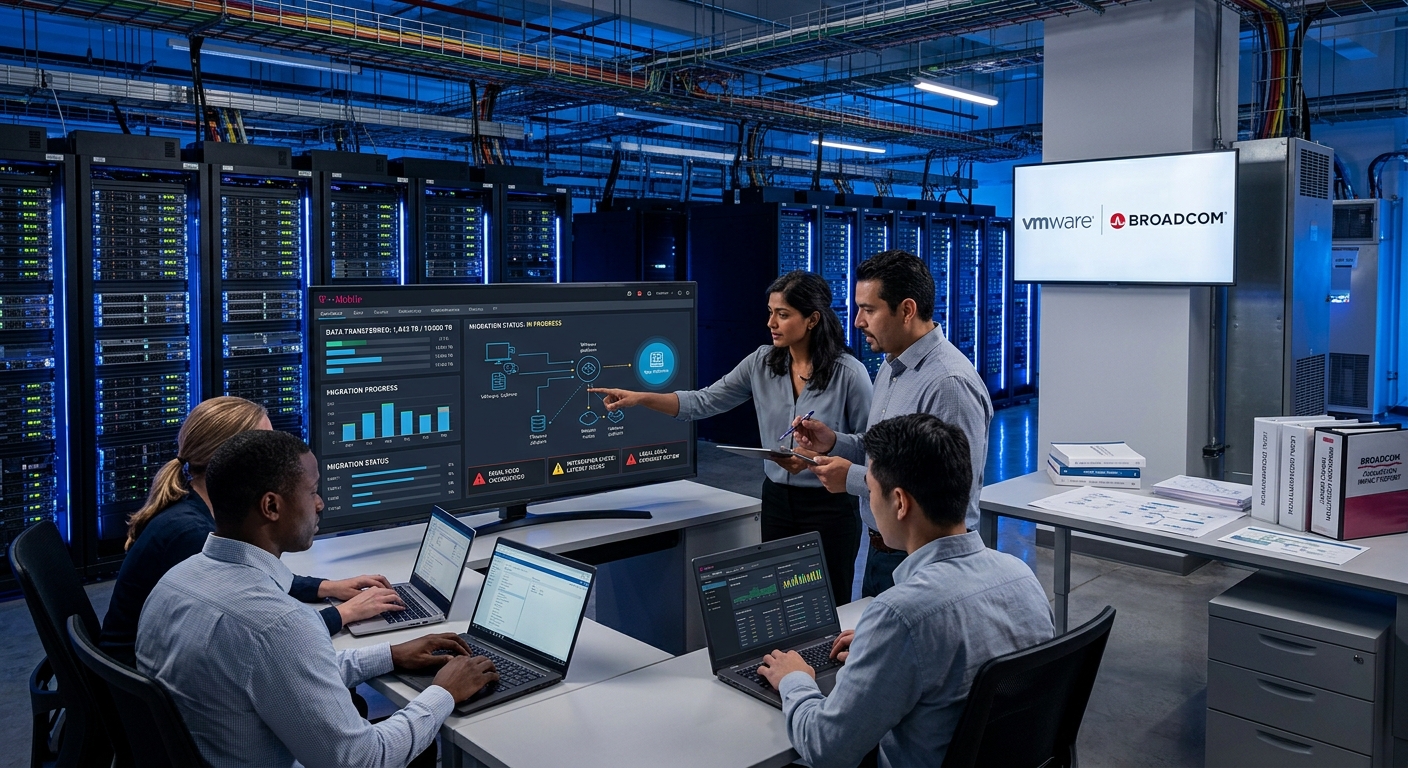
Technically, the migration involves complex live transfers of virtual machines using VMware tools such as HCX vMotion and Bulk Migration to ensure minimal downtime and continuity of service. However, T-Mobile faces substantial challenges in re-architecting its automation and monitoring systems, which were deeply integrated with VMware’s ecosystem, while simultaneously managing a migration of roughly 10,000 terabytes of data. The dispute has further strained collaboration between T-Mobile’s and Broadcom’s technical teams, complicating support interactions during this critical transition.
This conflict and migration underscore broader industry trends as large enterprises reassess virtualization vendors amid shifting licensing models and pricing strategies. While Broadcom defends its subscription approach citing customer adoption and revenue growth, T-Mobile’s case highlights the operational risks and financial burdens organizations can face when disengaging from entrenched vendor ecosystems. The ongoing legal and technical challenges faced by T-Mobile illustrate the complexities of managing large-scale infrastructure transitions under contentious commercial circumstances.
Background
T-Mobile US has relied heavily on VMware technology since 2008, with the virtualization platform serving as the foundation for its entire internal network and supporting over a thousand applications running across more than 303,000 CPU cores. This extensive deployment of virtual machines (VMs) has been described by the carrier’s counsel as critical to the operation of its network infrastructure. Over the years, T-Mobile developed a deep integration with VMware’s ecosystem, including tooling for deployment, automation, and monitoring tailored specifically to the platform.
Recently, T-Mobile proposed a $20 million payment for an additional two years of VMware support to facilitate a more gradual transition away from the platform, according to an affirmation by Kevin Luu, T-Mobile’s Vice President of Technology. The company’s intent to migrate away from VMware aligns with strategic changes and ongoing legal disputes involving the two firms, prompting T-Mobile to re-evaluate and re-architect its virtualization environment.
The migration process itself is complex, involving the live movement of VMs while maintaining network connections and application availability. Tools such as VMware’s vMotion and HCX application mobility platform are essential for ensuring continuity during migration, enabling workload rebalancing and minimizing downtime. Despite these capabilities, rebuilding the VMware-specific automation and monitoring systems on a new platform presents significant challenges.
This shift reflects broader trends within the industry, as wireless carriers explore alternatives and customers reconsider their service providers, with some favoring Mobile Virtual Network Operators (MVNOs) over traditional carriers like T-Mobile. The ongoing transition away from VMware marks a pivotal moment in T-Mobile’s operational evolution amid its efforts to modernize infrastructure and navigate competitive and legal pressures.
Legal Dispute
The legal dispute between T-Mobile and Broadcom centers on a contract originally struck between T-Mobile and VMware in August 2023. Under this agreement, T-Mobile acquired perpetual licenses—licenses without expiration—and two years of support for certain VMware software, with an option to purchase an additional year of support. However, shortly after Broadcom acquired VMware, it discontinued the sale of perpetual licenses and standalone support contracts, consolidating over 150 VMware products into two subscription-only bundles, primarily focused on the VMware Cloud Foundation (VCF) private cloud suite.
T-Mobile’s contention arises from Broadcom’s refusal to provide extended support under the original contract terms, arguing that the products covered by the agreement no longer exist and that its contracts allow denial of support for discontinued products. Broadcom maintains that subscriptions are now the industry standard, and “thousands upon thousands” of customers have successfully migrated to subscription models, making T-Mobile an outlier in pursuing litigation. The presiding judge, The Honorable Jennifer G. Shecter, who also oversaw a similar case between VMware and AT&T that resulted in a confidential settlement, indicated during an October 2025 hearing that T-Mobile’s case may be stronger than AT&T’s.
The dispute has reportedly hindered cooperation between T-Mobile’s VMware administrators and Broadcom’s support engineers, with both sides possibly instructed to adopt adversarial stances, complicating efforts to resolve technical issues amicably. A judge has ordered Broadcom to provide engineers to assist in transitioning to alternative software and has set a deadline of August 31st for compliance. Should Broadcom fail to deliver an acceptable product by this date—acceptable solely at T-Mobile’s discretion—it faces penalties of $10 million per month.
This ongoing conflict highlights the financial and technical challenges faced by organizations in litigating against a large conglomerate like Broadcom, which may deter smaller entities from pursuing similar actions. Meanwhile, Broadcom continues to bundle VMware products into more expensive subscription packages, which has been a point of contention not only for T-Mobile but also for other customers such as Tesco, who have accused Broadcom of abusive pricing and sought substantial damages.
Migration of Virtual Machines
T-Mobile’s migration of thousands of virtual machines (VMs) from VMware represents a significant and complex undertaking driven by both technical and legal challenges. The company reportedly operates approximately 303,140 CPU cores supporting tens of thousands of VMs across its internal network, which underpins over 1,000 applications. This scale of virtualization infrastructure makes the migration effort particularly daunting.
VM migration involves transferring VMs from one physical host or platform to another, often to improve load balancing, facilitate hardware upgrades, or enable cloud transitions without service disruption. VMware provides multiple migration methods including Bulk Migration, HCX vMotion, and Replication Assisted vMotion. These tools support live migration of VMs with minimal downtime by maintaining network connections and transferring memory states, and also enable cross-vCenter migrations essential for moves spanning multiple VMware clouds. However, T-Mobile’s migration extends beyond merely moving VMs; it also requires rebuilding VMware-specific tooling such as deployment, automation, and monitoring systems to function on the new platform.
The sheer volume of data involved poses a significant challenge. Estimates suggest T-Mobile needs to migrate roughly 10,000 TB of data at network speeds of 100-200 Mbps. Given the requirement to test, implement disaster recovery, and control changes carefully, executing the migration without outages is a massive technical effort. Additionally, the company has to navigate the complexities of maintaining application availability and security throughout the process.
T-Mobile’s migration has been influenced by its deteriorating relationship with VMware, now owned by Broadcom. The termination of VMware support agreements by Broadcom after 2025 and subsequent proposals for costly extended support packages led T-Mobile to seek alternative solutions. The telecommunications giant’s VP of Technology indicated that the migration strategy aims to proceed in a “more deliberate” manner to mitigate risks and minimize business impact. Legal disputes between the two parties have further complicated cooperation, impacting support interactions and overall migration progress.
Despite these difficulties, migration from VMware is seen by some as an industry trend, with large organizations increasingly pursuing alternatives to manage costs and avoid vendor lock-in. However, T-Mobile’s case highlights the financial and operational burdens involved in such transitions, particularly at large scale, underscoring why many companies opt to remain with VMware or migrate more gradually.
Impact of the Migration
The migration of thousands of virtual machines (VMs) from VMware by T-Mobile has had significant operational and strategic repercussions. This large-scale migration involved the use of comprehensive tools capable of various migration types such as Bulk Migration, HCX vMotion, and Replication Assisted vMotion, which facilitated the conversion of physical machines and non-vSphere virtual machines to vSphere-based VMs. These technologies are crucial for maintaining service continuity during transitions and optimizing infrastructure efficiency.
Strategically, the move highlights growing dissatisfaction with VMware’s support and business practices under Broadcom’s ownership. Broadcom’s acquisition strategy has been criticized for focusing on monetizing VMware’s existing market dominance rather than investing in product innovation or customer satisfaction. Reports indicate that tensions between Broadcom and major customers like T-Mobile have escalated to legal disputes, creating an adversarial environment that hinders productive technical collaboration and support. This adversarial climate has reportedly impacted the ability of VMware administrators and support engineers to resolve issues effectively within customer estates.
Financially, T-Mobile’s decision was partly influenced by the escalating costs associated with VMware support, including a notable $24 million incurred by Broadcom to provide dedicated support services and account management for T-Mobile. At one point, T-Mobile was willing to pay $20 million for two years of software updates and support, underlining the critical nature of uninterrupted service for its business operations. The litigation and associated support expenses contributed to T-Mobile’s reassessment of VMware as a sustainable long-term solution.
The migration also reflects broader market trends, with many customers exploring alternatives due to dissatisfaction with VMware and Broadcom’s approach. This is mirrored in consumer shifts toward more competitive mobile service providers, such as mobile virtual network operators (MVNOs), who offer comparable coverage at lower costs, indicating a wider climate of demand for cost-effective and efficient services. Meanwhile, Broadcom defends its strategy by arguing that customers adopting VMware Cloud Foundation (VCF) subscriptions benefit from improved infrastructure efficiency and enhanced business performance, citing revenue growth as validation of their approach.
Aftermath and Current Status
Following the dispute between T-Mobile and Broadcom over VMware support and licensing agreements, the relationship between the two companies has notably deteriorated. The conflict centers around a deal T-Mobile struck with VMware in August 2023, acquiring perpetual licenses and a two-year support term that Broadcom announced it would not renew after expiration in 2025. This decision prompted T-Mobile to seek alternatives and begin a deliberate migration away from VMware’s platform, underscoring the carrier’s intent to reduce reliance on Broadcom’s virtualization solutions.
The legal battle intensified when a judge ordered Broadcom to provide engineers to assist in the transition to another company’s software, with a deadline set for August 31st, 2025. Should Broadcom fail to deliver a product acceptable to T-Mobile by this date, the company faces penalties of $10 million per month. This judicial intervention highlights the severity of the dispute and the operational risks faced by T-Mobile during the transition.
Despite Broadcom’s assertions that customers migrating to VMware Cloud Foundation (VCF) subscriptions experience enhanced infrastructure efficiency and improved business performance—citing strong revenue growth as validation of its strategy—the ongoing litigation portrays T-Mobile as an outlier resisting this shift. Broadcom representatives emphasize that thousands of customers have successfully transitioned to subscription models and accepted the end-of-support terms, framing T-Mobile’s legal actions as exceptional.
T-Mobile’s approach, articulated by Vice President of Technology Kevin Luu, involves negotiating for extended support to ensure a smoother migration process. The company proposed a $20 million deal for an additional two years of support, intending to complete the transition “at a more deliberate pace”. This cautious stance reflects the complexity and scale of moving thousands of virtual machines, given the critical nature of the underlying infrastructure that supports thousands of applications within T-Mobile’s internal network.
In practical terms, T-Mobile has been utilizing various migration tools to facilitate this transition, including Bulk Migration, HCX vMotion, and Replication Assisted vMotion. These tools enable large-scale migration efforts, particularly for converting physical machines or non-vSphere virtual machines into vSphere-based virtual machines, which is essential for integrating existing infrastructure into new virtualized environments during cloud migration.
The content is provided by Avery Redwood, Anchor Press