
Putin Embraces Controversial Tactics: Attacks on Ukraines Holiest Sites Reveal Alarming Parallels to Nazi Strategy
Summary
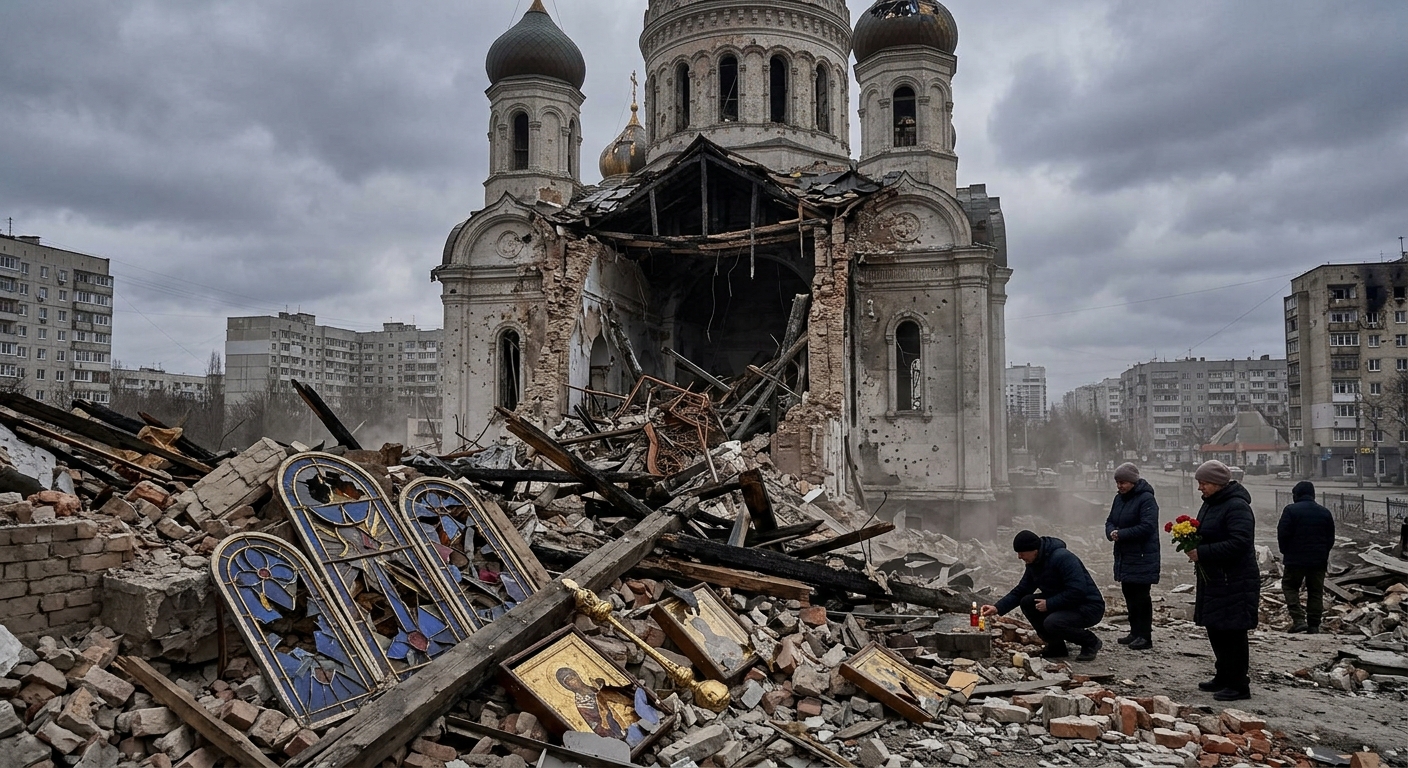
The deliberate targeting and destruction of Ukraine’s cultural and religious heritage during the ongoing conflict has emerged as a significant and deeply troubling aspect of Russia’s military campaign. Since the 2022 invasion, over 238 cultural sites—including churches, museums, monuments, and libraries—have been damaged, looted, or destroyed, with nearly half of the affected Christian sites belonging to the Ukrainian Orthodox Church, which formally severed ties with the Moscow Patriarchate in 2022. These attacks are widely recognized as more than incidental collateral damage; they constitute a strategic effort to erode Ukrainian national identity and morale, raising serious concerns of war crimes under international humanitarian law, including the 1954 Hague Convention and the Rome Statute of the International Criminal Court.
Russian President Vladimir Putin has framed the invasion partly as a “denazification” mission, invoking historical narratives of World War II to justify the conflict. This rhetoric, however, has been extensively debunked by scholars and historians as propaganda, while the physical destruction of Ukraine’s cultural and religious sites parallels tactics employed by the Nazi regime aimed at obliterating cultural memory and religious diversity. The conflict has seen high-profile assaults on sacred sites such as the Kyiv-Pechersk Lavra’s Dormition Cathedral, drawing international condemnation and symbolic comparisons to attacks on globally revered landmarks like Notre Dame Cathedral in Paris.
The military strategy underpinning these attacks includes long-range missile and drone strikes deliberately aimed at civilian and symbolic targets to demoralize the population and disrupt the social fabric that sustains Ukrainian resistance. Alongside physical destruction, Russian occupation authorities have reportedly engaged in harassment and repression of religious communities, particularly those resisting Moscow’s influence, further intensifying the assault on Ukraine’s spiritual and cultural autonomy. This combination of military, ideological, and propaganda efforts reflects a broader “memory warfare” strategy designed to rewrite historical narratives and suppress Ukrainian identity.
International responses have emphasized the illegality and immorality of these actions, with the United Nations, UNESCO, and numerous governments condemning the attacks and calling for accountability. Investigations by the International Criminal Court and legal provisions under international law highlight the potential for prosecuting these acts as war crimes. The destruction of Ukraine’s cultural heritage thus stands as both a humanitarian tragedy and a stark reminder of how cultural and religious sites become battlegrounds in contemporary conflicts, evoking alarming parallels to past totalitarian strategies.
Background
The ongoing conflict in Ukraine has brought to light disturbing historical parallels and the deliberate targeting of cultural and religious heritage as a tactic of warfare. Prior to the 2022 Russian invasion, Ukrainian territory contained seven UNESCO World Heritage Sites, reflecting the country’s rich cultural and religious history. Since the invasion, over 238 cultural sites, including religious buildings, museums, monuments, and libraries, have been damaged, looted, or destroyed. Notably, nearly half of the Christian religious sites affected belong to the Ukrainian Orthodox Church, which formally declared its independence from the Moscow Patriarchate in May 2022.
The destruction of cultural, national, and religious identity has become a strategic element of Russian aggression, particularly in the occupied territories. The targeting of these sites is more than collateral damage; it is recognized under international law as a potential war crime. The 1954 Hague Convention for the Protection of Cultural Property in the Event of Armed Conflict, along with its protocols, and the Geneva Convention Additional Protocols I and II, enshrine the obligation to protect cultural heritage during armed conflicts. Deliberate attacks against such sites may constitute grave breaches, prosecutable by the International Criminal Court, unless justified by “imperative military necessity” when no feasible alternatives exist.
The political narrative framing the conflict has drawn on historical grievances and interpretations. Russian President Vladimir Putin justified the invasion partly through claims of “denazification” of Ukraine, alleging ongoing genocide against Russian-speaking populations in the east. These assertions invoke Ukraine’s history of Nazi occupation during World War II as a rationale for military action. This invocation of Nazi-era symbolism and propaganda echoes earlier instances where such imagery was employed to manipulate public perception and justify aggressive policies, as seen in Nazi Germany’s own use of potent visual and ideological messaging.
The scale of damage to Ukrainian cultural heritage has been exacerbated by the intensity of drone and missile strikes, with reports highlighting the destruction of important institutions such as Mariupol’s Arkhip Kuindzhi Art Museum, which housed thousands of significant Ukrainian artworks. Efforts to safeguard remaining heritage include protective measures in cities like Lviv, where historic statues and religious icons have been shielded to prevent further loss.
The destruction and appropriation of religious and cultural sites reflect a broader campaign aimed at eroding Ukrainian identity and autonomy. Religious communities, such as Jehovah’s Witnesses, have reported extensive damage to their places of worship, highlighting the widespread nature of this cultural devastation. The international community recognizes the urgent need to document and respond to these violations to preserve Ukraine’s cultural legacy and uphold the laws protecting heritage in armed conflict.
Documented Attacks on Religious and Cultural Sites
Russia’s military campaign in Ukraine has involved widespread attacks on religious and cultural heritage sites, which have become internationally recognized symbols of the broader targeting of Ukraine’s spiritual and historical identity. These attacks have been meticulously documented by multiple organizations. The United Nations Office of the High Commissioner for Human Rights (OHCHR) through its Human Rights Monitoring Mission in Ukraine, the Ukrainian Ministry of Culture, and the Ukrainian Council of Churches and Religious Organizations maintain overlapping registries recording damage to religious buildings and cultural property. International bodies such as Blue Shield International and the ASOR Cultural Heritage Initiatives also contribute independent data on these violations.
Between February 24, 2022, and April 30, 2023, nongovernmental organizations reported that at least 532 burial sites and places of worship were damaged or destroyed, with other reports indicating the destruction, damage, or looting of over 630 religious buildings and sacred sites by Russian occupying authorities. The regions hardest hit include Donetsk, Luhansk, Kyiv, Kharkiv, and Kherson, with the largest numbers of damaged sites concentrated in Donetsk and Luhansk. Almost half of the Christian sites affected belong to the Ukrainian Orthodox Church, underscoring the significant religious impact of the conflict.
High-profile attacks have drawn international condemnation, such as the missile and drone strikes on the Dormition Cathedral of the Kyiv-Pechersk Lavra in June 2026, which resulted in a fire damaging the cathedral’s roof. This sacred Orthodox Christian site, one of Ukraine’s most revered, was likened by French Foreign Minister Jean-Noel Barrot to an attack on Notre Dame Cathedral in Paris. Ukrainian religious leaders condemned the strike as a crime against humanity, history, and Christianity, emphasizing the symbolic and cultural devastation caused by these assaults.
These attacks violate international humanitarian law, which requires parties to armed conflict to take all feasible precautions to avoid or minimize incidental damage to civilian objects, including places of worship and cultural property. The Second Protocol to the Hague Convention explicitly mandates such protections, underscoring that attacks on cultural heritage sites are prohibited and must be avoided whenever possible.
Beyond physical destruction, Russia’s occupation has involved other abuses against religious communities, including detention of clergy and attempts by Russian intelligence to recruit Ukrainian youth for antisemitic acts. Mass graves and sites of torture have been uncovered in liberated areas, reflecting the severe human rights abuses accompanying the attacks on cultural heritage.
The widespread targeting of religious and cultural sites in Ukraine reveals an alarming pattern of deliberate desecration and destruction that parallels historical tactics used to undermine national identity and morale. This has galvanized calls within Ukraine and internationally to increase pressure on Russia to cease these actions and respect international norms protecting cultural heritage during armed conflict.
Strategic Rationale and Military Tactics
Russian military operations in Ukraine have employed a range of tactics that reflect a calculated strategy to undermine Ukrainian resistance not only through direct military engagement but also by targeting symbolic and civilian structures. Following an escalation in hostilities, including missile and drone strikes neutralized to a significant extent by Ukrainian air defenses, Russia’s approach has included the deployment of strategic deterrence forces under heightened combat readiness, a move justified by Moscow as a response to “unfriendly actions” and “aggressive statements” from Western nations.
A hallmark of Russian tactics has been the deliberate shelling of nonmilitary areas from long distances. This strategy aims to demoralize the Ukrainian population and compel civilians to flee urban centers, thereby weakening the societal fabric that supports Ukrainian defense efforts. Such indiscriminate attacks complicate the distinction between intentional targeting of landmarks and collateral damage, raising concerns over violations of international humanitarian law which mandates precautions to avoid or minimize harm to cultural and religious sites during armed conflict.
Beyond the immediate military objectives, these attacks reveal a deeper strategic rationale tied to what has been described as “memory warfare.” This concept involves efforts to manipulate the collective memory of a population by destroying institutions, symbols, and records that preserve historical identity and national narrative. For example, strikes on museums linked to the Soviet legacy—such as those connected to the Chornobyl disaster—serve not only as physical destruction but also as an assault on the cultural memory that informs contemporary Ukrainian identity and resistance.
This strategy has drawn international condemnation, with officials likening the destruction of Ukrainian cultural sites to symbolic attacks on iconic landmarks in other countries, such as the French Foreign Minister’s comparison to the bombing of Notre Dame Cathedral in Paris. The targeting of religious institutions further underscores the intertwining of military objectives with ideological warfare. Since the invasion began, over a hundred religious sites have been damaged, with evidence of widespread abuses including shelling, looting, and the detention of clergy in both occupied and government-controlled areas.
These tactics also intersect with the ideological framing promoted by Russian state-aligned media and ultra-conservative voices, which have increasingly portrayed the conflict as a “holy war.” This narrative emerged prominently following setbacks in the Kharkiv region and growing internal criticism, serving as a means to justify the war and mobilize public support despite its rising unpopularity.
Ideological and Propaganda Dimensions
The ideological underpinnings of the Russian invasion of Ukraine have been significantly shaped by a renewed promotion of ultra-conservative and nationalist narratives, which gained prominence in Russian media following setbacks in the war. Notably, the concept of a “holy war” was officially adopted as a central justification for the aggression against Ukraine in late August to early September 2022. This shift was influenced by various factors, including unexpected Russian military defeats, internal criticism from ultra-conservatives and nuclear patriots, the need for mobilization, and signs of waning public support for the conflict among Russians.
Central to the propaganda effort has been the portrayal of the war as a fight against alleged “fascists” and “Nazis” within the Ukrainian leadership. However, this rhetoric has been widely challenged by scholars and experts. More than 300 historians specializing in genocide, Nazism, and World War II signed a statement denouncing President Putin’s claims of “de-Nazifying” Ukraine as baseless propaganda. This narrative echoes historical instances of targeted propaganda campaigns, such as those employed by the Nazis themselves, who strategically manipulated specific groups through niche marketing techniques to advance their ideological goals.
Religious elements have also been weaponized in the conflict. Attacks on Ukrainian churches and clergy are viewed by local Christians and international observers as part of a broader Russian campaign against religious freedom in Ukraine and Russian-occupied territories. Legislative efforts in the United States, such as the “Countering Russia’s War on Faith Act,” seek to impose sanctions on individuals responsible for these religious persecutions, emphasizing that the Russian state, under Putin’s leadership and Patriarch Kirill’s influence, systematically targets faith communities that resist state control.
Scholars like Jason Stanley of Yale University argue that antisemitism and Christian nationalism are integral to Putin’s worldview, framing him as a leader who embodies Russian Christian nationalism on a global scale. Although some experts caution against labeling the invasion strictly as a religious war, it is widely recognized that the Russian Orthodox Church has resumed a czarist-era role as an instrument of state policy, effectively becoming the political religion underpinning Russian Orthodoxy nationalism. This intertwining of religion and state policy not only fuels the conflict but also risks perpetuating long-term divisions. The weaponization of religious schisms may engender cycles of retribution and hinder future reconciliation efforts, as the consequences of such prejudices often persist well beyond active hostilities.
The deliberate targeting and destruction of religious and cultural heritage sites further underscore the ideological dimensions of the war. Over 590 religious objects across various denominations have been damaged or destroyed, primarily in regions experiencing active combat, but also in other areas under Russian occupation. These attacks contravene international humanitarian law, which mandates the protection of religious buildings of cultural significance and prohibits their use for military purposes. Despite these protections, numerous cultural institutions, including educational and artistic venues, have been intentionally targeted, with documented losses reaching thousands of sites and incalculable damage to Ukraine’s cultural sector. Such widespread devastation has drawn comparisons to historical campaigns aimed at erasing cultural identities and constitutes potential war crimes under international law, as enshrined in treaties like the 1954 Hague Convention and the Rome Statute of the International Criminal Court.
Parallels to Nazi Strategies of Cultural and Religious Destruction
The systematic destruction and targeting of Ukraine’s cultural and religious sites during the ongoing conflict reveal disturbing parallels to Nazi strategies employed in the mid-20th century. During World War II, the Nazi regime engaged in widespread looting and demolition of art, religious institutions, and cultural heritage across occupied Europe. Smaller religious minorities, such as Jews and Jehovah’s Witnesses, were subjected to brutal persecution under Nazi racial and ideological policies, including expulsion and extermination. The Nazis also confiscated monasteries and religious properties in Germany and Austria, often under false pretexts such as wartime necessity, while suppressing religious expression through censorship and repression.
Similarly, the current conflict has resulted in the partial or total destruction of over 150 cultural sites in Ukraine, including 70 religious buildings, alongside historical monuments, museums, and libraries. These attacks are not merely collateral damage but appear to be deliberate efforts aimed at erasing Ukrainian cultural memory and identity. Ukrainian officials and international observers have condemned these acts as violations of international humanitarian law and calls have been made to protect cultural heritage under the Hague Convention. France’s Foreign Minister compared the destruction of Ukrainian cultural landmarks to a symbolic attack akin to bombing Notre Dame in Paris, underscoring the global significance of these losses.
The targeting of cultural and religious symbols forms part of a broader “memory warfare” strategy, where physical attacks on institutions of remembrance are coupled with propaganda, curricular revision, and archival suppression to reshape public understanding of history and identity. This mirrors the Nazi approach of subordinating or destroying religious institutions to impose their ideological worldview, as Hitler envisioned a future where Christianity would be either eradicated or radically transformed to align with Nazi ideals.
Russian state narratives surrounding the conflict have also drawn heavily on mythologized interpretations of history, including attempts to recast the struggle as a “holy war” against fascism, echoing Nazi-era ideological manipulation. This weaponization of historical memory, combined with the physical destruction of Ukraine’s cultural and religious sites, evokes the calculated cultural and religious destruction orchestrated by the Nazis. Such tactics aim not only at military domination but at the erasure and subjugation of a people’s cultural and spiritual foundations, revealing alarming continuities between past and present strategies of totalitarian aggression.
Specific Cases and Statements Illustrating Intent
The destruction and damage inflicted on religious sites during the conflict in Ukraine have raised significant concerns about the intent behind these attacks. According to the “Religion on Fire” project, over 590 religious objects of various denominations have been shelled, primarily in regions experiencing active combat, but also in other areas, indicating a widespread pattern rather than isolated incidents. This damage disproportionately affected Ukrainian Orthodox churches—despite their contested ties to the Moscow patriarchate—with 187 such churches reported damaged or destroyed by Russian forces.
Faith leaders and observers note that churches unwilling to cooperate with occupation authorities face harassment, closure, or expulsion, while those perceived as supportive of Russian governance receive preferential treatment. This selective targeting reflects an effort to reshape Ukrainian society under Russian control through religious and cultural domination. Additionally, Ukraine has begun to consider imposing limitations on religious organizations linked to Russia, signaling official concern over external influence via religious institutions.
The strategic
International Legal Framework and Accountability
The deliberate destruction and targeting of cultural heritage during armed conflict is governed by a comprehensive international legal framework that has evolved significantly since the late 19th century. The foundation of this framework lies in the 1899 and 1907 Hague Conventions, which initially urged the protection of religious, educational, scientific, hospital, and charitable institutions “as far as possible.” However, widespread devastation during World War II underscored the necessity for stronger protections, leading to the adoption of the 1954 Hague Convention for the Protection of Cultural Property in the Event of Armed Conflict and its two Protocols in 1954 and 1999. These conventions establish the principle that cultural property must be safeguarded from destruction or damage during conflicts, with large parts of the convention considered customary international law.
The 1954 Hague Convention defines “cultural property” broadly, encompassing immovable cultural property regardless of origin or ownership, including monuments, museums, religious buildings, and cultural centers. Significantly, the convention introduced measures such as marking protected sites with the distinctive “Blue Shield” emblem to prevent deliberate or accidental harm. Additional protection is afforded by the Geneva Convention Additional Protocols I and II (1977), which emphasize the safeguarding of cultural and religious sites and classify their deliberate destruction in international armed conflicts as a grave breach potentially amounting to war crimes.
The Rome Statute of the International Criminal Court (ICC), effective since 2002, has further expanded the scope of legal protection by explicitly criminalizing the intentional targeting of cultural heritage. Articles 8(2)(b)(ix) and 8(2)(e)(iv) extend protection to buildings dedicated to religious, educational, scientific, hospital, and charitable purposes, as well as historical monuments and artefacts, covering both international and non-international armed conflicts. The ICC requires that for an act to qualify as the destruction of cultural heritage constituting a war crime, it must occur within the context of an armed conflict and be closely linked to the hostilities, a nexus established through case law from the International Criminal Tribunal for the Former Yugoslavia (ICTY) and Rwanda (ICTR).
The Second Protocol to the 1954 Hague Convention permits attacks on cultural property solely under conditions of “imperative military necessity,” when no feasible alternative exists. Any attacks outside this narrow exception are prosecutable as war crimes before the ICC. This legal framework reflects the international community’s recognition of the cultural and historical significance of such sites and the grave consequences their destruction can have, including cultural genocide as described by Ukrainian officials in the context of the recent conflict.
In response to ongoing violations in eastern Ukraine since 2014, UNESCO has actively documented and monitored damage to cultural heritage, reporting that by June 2022, 152 cultural sites—including religious buildings, museums, and monuments—had been partially or completely destroyed. While none of Ukraine’s seven UNESCO World Heritage Sites had been affected to date, UNESCO’s efforts include developing mechanisms for independent assessment using satellite imagery and coordinating with Ukrainian authorities to mark and protect vulnerable sites. The organization has also established a dedicated fund and appealed for international contributions to support Ukraine’s cultural heritage protection and eventual reconstruction.
On the accountability front, the ICC has taken concrete steps to investigate and prosecute alleged war crimes related to the conflict in Ukraine. Following a referral by 39 states parties, the ICC Prosecutor opened a formal investigation in March 2022. In March 2023, the court issued arrest warrants for Russian President Vladimir Putin and Maria Lvova-Belova, underscoring the seriousness of violations, including those targeting cultural property. Furthermore, domestic Ukrainian legal measures have been reinforced, such as the direct subordination of the Department for State Expert Supervision (DESS) to the Cabinet of Ministers to enhance oversight of religious and cultural institutions potentially linked to foreign influence, further supporting accountability efforts.
International Reactions and Diplomatic Responses
The international community has widely condemned the attacks on Ukraine’s cultural and religious sites, viewing them as part of a broader strategy that threatens humanitarian norms and cultural heritage. Ukraine’s Ministry of Culture spokesperson Heorhii Tykhyi emphasized that mere condemnation is insufficient and called for concrete actions, such as imposing sanctions against Russia in the cultural sector and barring Russian representatives from international cultural events to ensure Russia’s complete isolation.
United Nations bodies have played a prominent role in addressing the conflict and its consequences. The UN General Assembly has passed numerous resolutions demanding humanitarian access for civilians, condemning Russia’s annexation of occupied Ukrainian territories, and insisting on reparations and justice for violations of International Humanitarian Law (IHL). Despite these efforts, Russian forces have intensified attacks on civilian infrastructure, worsening the humanitarian crisis amid harsh winter conditions. The UN Security Council meetings have also highlighted the right of Ukraine to self-defense under Article 51 of the UN Charter, with member states criticizing Russia’s attempts to delegitimize lawful arms transfers to Ukraine.
Regional organizations have voiced their concerns and called for peaceful resolutions. The African Union’s Commission Chairman Moussa Faki and Senegalese President Macky Sall urged all parties, including Russia, to respect Ukraine’s territorial integrity and sovereignty and to initiate immediate ceasefires and political negotiations. Similarly, all member states of the Arctic Council, except Russia, issued a joint statement condemning the invasion as a blatant violation of the organization’s core principles of sovereignty and territorial integrity.
The religious dimension of the conflict has attracted particular international attention. Analysts and human rights organizations report that Russian authorities have co-opted the Ukrainian Orthodox Church structures in occupied areas to serve political and administrative purposes, blending religious influence with state control. Churches that resist cooperation face harassment or closure, while those supportive of Russian governance receive preferential treatment, signaling an attempt to reshape Ukrainian society under occupation. Human Rights Without Frontiers documented the systematic destruction of religious life in occupied territories, noting that hundreds of places of worship across different faiths—including churches, mosques, and synagogues—have been damaged or destroyed since the 2022 invasion.
UNESCO has taken an active role in monitoring and safeguarding Ukraine’s cultural heritage amid the conflict. In collaboration with partner organizations, it is developing mechanisms for independent assessment, including satellite image analysis, aligned with the 1954 Hague Convention for the Protection of Cultural Property in the Event of Armed Conflict. This includes marking cultural sites with the distinctive “Blue Shield” emblem to prevent deliberate or accidental damage. Although no UNESCO World Heritage sites have been affected so far, the organization has established a dedicated fund for future reconstruction and launched an appeal for international support. The legal framework protecting cultural heritage also includes the 1970 UNESCO Convention aimed at preventing illicit trafficking of cultural property, highlighting the evolving nature of conflicts and the need for enhanced protections.
French Foreign Minister Jean-Noel Barrot underscored the symbolic weight of the attacks by comparing them to the bombing of Notre Dame Cathedral in Paris, reflecting the deep cultural loss represented by the destruction in Ukraine. Ukraine’s National Commission for UNESCO has called on the international community to intensify pressure on Moscow, including efforts to expel Russia from the organization.
International humanitarian law explicitly mandates precautions to protect civilian life and cultural sites during armed conflicts. The Second Protocol to the Hague Convention requires all parties to minimize incidental harm to civilians and to safeguard places of worship and cultural property, violations of which constitute prosecutable offenses under international law. The targeting of Ukraine’s religious and cultural heritage has thus elicited strong diplomatic responses, framing these attacks not only as military actions but also as assaults on human rights and international legal norms.
Impact on Ukraine
The Russian invasion of Ukraine in 2022 has led to significant devastation across the country, severely impacting Ukraine’s cultural, religious, and national identity. The regions most affected include Donetsk, Kyiv, Kharkiv, Kherson, and Luhansk, where extensive destruction has been documented not only of civilian infrastructure but also of churches and other sacred sites. Researchers have noted that some of these religious buildings were deliberately desecrated during the Russian occupation, highlighting a targeted effort to undermine Ukraine’s cultural and spiritual heritage.
A particularly striking aspect of the conflict has been the systematic attacks on Ukraine’s cultural institutions. For instance, the Mystetskyi Arsenal, a prominent venue for cultural events, was struck, and the Dovzhenko Film Studios suffered a missile attack that destroyed a valuable costume collection containing approximately one hundred thousand items. These attacks suggest an escalation in efforts to erase symbols of Ukrainian national heritage, reflecting a broader strategy to diminish the country’s cultural identity.
The destruction extends beyond material damage to include an assault on the right to cultural, national, and religious self-determination, which has become a central element of Russian aggression in the occupied territories. The targeting of religious buildings is particularly significant because these sites serve as centers of faith and community life, as well as repositories of irreplaceable art and architectural heritage. Under international humanitarian law, such buildings are specifically protected from attack, underscoring the severity of these violations.
This pattern of destruction echoes historical precedents where ideological and religious conflicts led to the devastation of cultural heritage, often as a means to assert control and redistribute power. In the context of Ukraine, these actions have been accompanied by rhetoric denying the existence of Ukrainian culture and statehood, further exacerbating the cultural assault.
The scale of the damage has been substantial: by June 2022, UNESCO reported that 152 cultural sites had been partially or completely destroyed, including 70 religious buildings, 30 historical buildings, 18 cultural centers, 15 monuments, 12 museums, and seven libraries. UNESCO’s Director-General, Audrey Azoulay, condemned these attacks, emphasizing that cultural heritage must never be targeted in armed conflict and called for respect of international humanitarian law, particularly the Hague Convention on the Protection of Cultural Property.
Ultimately, the destruction of Ukraine’s cultural heritage represents not only a loss of material objects but also an attack on the meaning and identity these sites hold for individuals and communities. This deliberate targeting seeks to undermine the morale and legacy of the Ukrainian people, illustrating the enduring importance of cultural heritage in conflicts and raising urgent questions about the effectiveness of existing legal protections.
Media Coverage and Public Perception
Russian state media and propaganda have played a significant role in shaping public perception regarding the conflict in Ukraine, often relying on misleading narratives and historical distortions. Moscow-based correspondents and outlets have frequently depicted Ukraine as dominated by “Nazism,” a claim widely rejected by experts and international historians as unfounded propaganda. This rhetoric has been systematically used within Russia as a justification for aggressive policies and military actions against Ukraine, despite the absence of credible evidence supporting these allegations.
Internationally, these tactics have generated skepticism and condemnation. Over 300 historians specializing in genocide, Nazism, and World War II signed statements denouncing Russian claims of “de-Nazification” as deliberate misinformation. Institutions like the Auschwitz-Birkenau State Museum have also publicly condemned Putin’s accusations, emphasizing that while Ukraine, like many countries, has extremist elements, these do not justify Russia’s invasion or its broad mischaracterization of the Ukrainian government.
The media discourse extends beyond verbal accusations to tangible acts, as seen in Russia’s attacks on Ukraine’s cultural and religious heritage sites. The destruction of landmarks such as the Kyiv-Pechersk Lavra and the House of the Gospel Church in Zaporizhzhia has been widely reported and condemned by Ukrainian officials and international observers. Ukrainian spokespersons have called for stronger sanctions and cultural isolation of Russia, demanding that Russian representatives be barred from global cultural events as a response to these attacks.
These assaults on cultural and religious sites are interpreted as part of a broader “memory warfare,” aiming to undermine Ukrainian national identity by targeting institutions and symbols that preserve its historical narrative. The strike on sites linked to the Soviet past, like museums associated with the Chernobyl disaster, exemplifies attempts to impose concrete losses on Ukrainian remembrance institutions and signal disdain for the historical perspectives they maintain.
Russian media outlets such as Tsargrad have further amplified ideological justifications for the conflict, promoting the notion of a “holy war” to frame the invasion within a religious and nationalist context. This narrative gained traction after military setbacks and declining public support, serving to mobilize the Russian populace and consolidate ultra-conservative backing for the war effort.
The international community’s media coverage often highlights the dissonance between Russian claims and the realities on the ground, emphasizing the extensive damage to religious leaders and cultural heritage as part of Russia’s broader war strategy. This coverage underscores global condemnation of continued military support to Russia from countries like Iran, Belarus, and the DPRK, which exacerbates the conflict and civilian suffering in Ukraine.
The content is provided by Avery Redwood, Anchor Press