Trumps Mount Rushmore Speech: From Celebrating American Greatness to Urgent Warnings
Summary
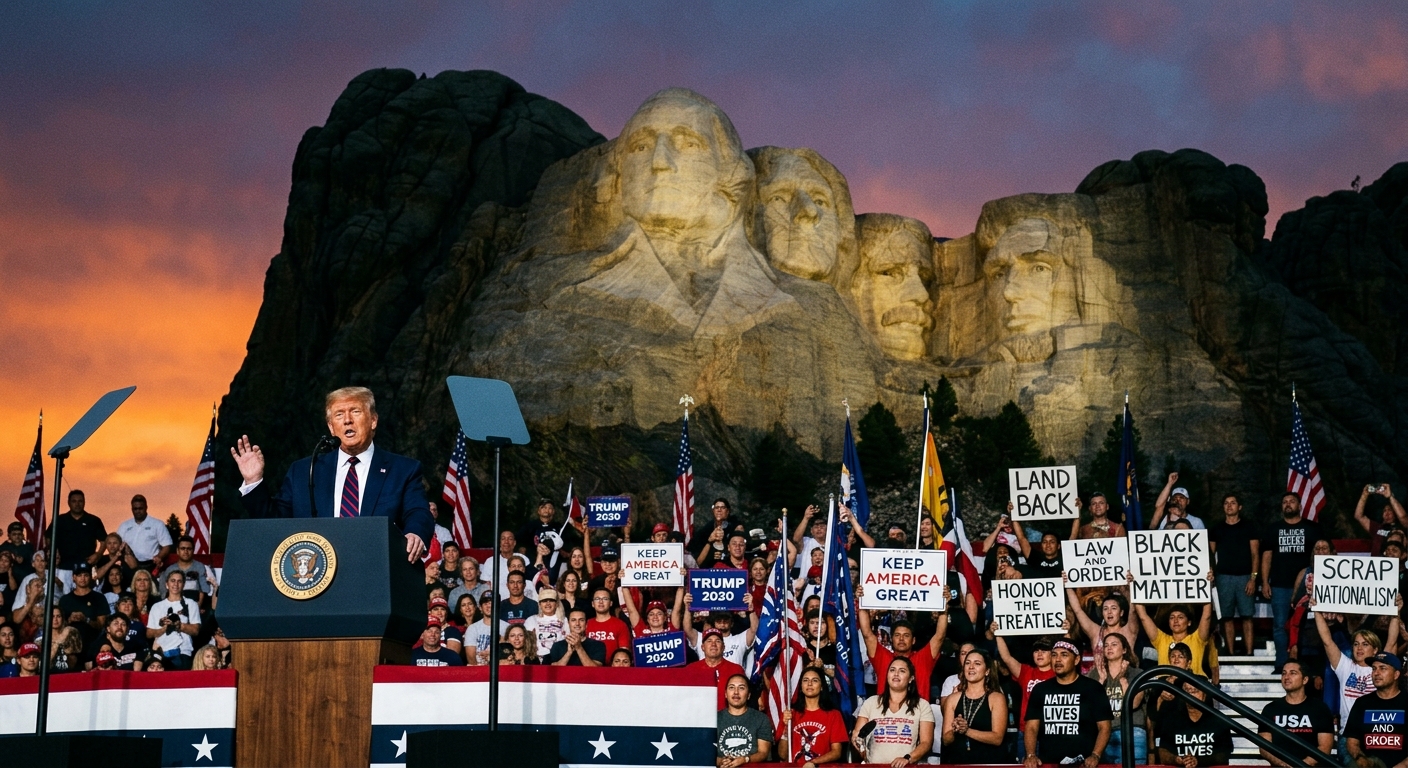
President Donald Trump’s Mount Rushmore speech, delivered on July 3, 2020, represents a notable moment in the intersection of American nationalism, historical symbolism, and contemporary political rhetoric. Given at the iconic Mount Rushmore National Memorial—featuring the monumental carved faces of George Washington, Thomas Jefferson, Theodore Roosevelt, and Abraham Lincoln—the speech was framed as a celebration of “American greatness” and a defense of traditional historical narratives against what Trump described as a growing “communist” and “far-left” threat to the nation’s founding principles. The event stood out for its overtly political and confrontational tone, diverging from the unifying and apolitical messages typically associated with Independence Day addresses at the site.
Mount Rushmore itself is a highly contested symbol, situated in the Black Hills of South Dakota, land sacred to the Lakota Sioux and other Native American tribes. The monument’s creation involved the seizure of Indigenous territory in violation of the 1868 Treaty of Fort Laramie, and it has long been criticized for celebrating presidents whose legacies include slavery, Indigenous displacement, and colonial expansion. Trump’s speech notably sidestepped these historical controversies, instead promoting an uncompromising patriotic vision that aligned with his administration’s broader efforts to resist critiques of America’s past and uphold a traditionalist interpretation of national history.
The speech drew sharp criticism and sparked debate across the political spectrum. Critics accused Trump of inflaming divisions by evoking Cold War–era anti-communist rhetoric and framing patriotism as incompatible with progressive or leftist political views. Supporters saw the address as a robust affirmation of American exceptionalism, while opponents highlighted its dismissive stance toward Indigenous concerns and its role in deepening partisan polarization. The event and its rhetoric have since been analyzed as emblematic of Trump’s nationalist populist style, reflecting broader cultural conflicts over historical memory and identity in the United States.
In the aftermath, the speech’s legacy continued to influence debates over public monuments, historical interpretation, and political discourse. Trump’s invocation of Mount Rushmore underscored the enduring power of national symbols in shaping public consciousness and highlighted the contentious nature of how American history is commemorated—issues that remain central to the country’s ongoing struggles with race, history, and national identity.
Background
Mount Rushmore National Memorial, located in the Black Hills of South Dakota, features the 60-foot-tall faces of four prominent United States presidents: George Washington, Thomas Jefferson, Theodore Roosevelt, and Abraham Lincoln. The monument serves as a patriotic tribute to these leaders and symbolizes key moments in American history. However, its creation was marked by controversy, both due to its location on sacred Native American land and the background of its sculptor, who had ties to the Ku Klux Klan. The Black Hills hold profound spiritual significance for the Lakota Sioux, the indigenous people originally inhabiting the region, which has led to ongoing disputes about the monument’s symbolism and impact.
The site has been a focal point for national events and celebrations, notably the Independence Day festivities, which have drawn large crowds and significant security measures. For instance, during one such event, Native American cultural elements were present alongside officials like Interior Secretary Doug Burgum and South Dakota Governor Larry Rhoden, highlighting a blend of tradition and political ceremony. These gatherings often underscore the tension between honoring American history and addressing contemporary social and political divisions.
In recent years, Mount Rushmore has become intertwined with political discourse, especially under the presidency of Donald Trump. His speeches at the monument have emphasized a glorified view of the nation’s past while critiquing efforts to reexamine historical faults. This perspective has played a central role in his 2020 and 2024 presidential campaigns, resonating with shifting public sentiment and framing an assertive cultural agenda during his administration.
Content of the Speech
President Donald Trump’s speech at Mount Rushmore on the eve of Independence Day was marked by a stark departure from the traditionally apolitical and unifying tone of past presidents’ addresses at similar high-profile events. Delivered at a national park commemorating some of America’s most prominent presidents, the speech emphasized themes of American strength, national identity, and historical greatness, while issuing urgent warnings against perceived ideological threats.
Trump framed the United States as a unique and exceptional society, describing it as “the greatest society in the history of civilization” and congratulating the audience by stating, “You live in a very special place — congratulations, everybody.” He rededicated the nation to the spirit of the founding figures memorialized at Mount Rushmore, calling them “American Giants” who could only have been made in the USA. The president urged Americans to aspire to be as “big, bold, noble, and as great” as these heroes.
A significant portion of the speech was devoted to an intense critique of communism, which Trump characterized as the “enemy of free people everywhere” and “the enemy of July 4th, 1776.” He declared communism to be “the exact opposite of life, liberty, and the pursuit of happiness,” associating it with “death, tyranny and the pursuit of evil.” Trump warned that communism posed a “mortal threat to American liberty,” surpassing even historical crises such as World Wars, Pearl Harbor, and 9/11. He presented a dichotomy between loyalty to Karl Marx and loyalty to America, asserting, “You can be a communist, or you can be a patriot. You cannot be both.” This rhetoric echoed the anti-communist fervor reminiscent of the 1950s Red Scare, with implications of ideological persecution and blacklisting.
The speech briefly referenced contemporary challenges, including the COVID-19 pandemic, with Trump thanking first responders and scientists for their efforts to combat the virus. However, this acknowledgment was cursory amid the broader themes of national pride and ideological confrontation.
Trump’s address diverged sharply from the conciliatory tones of previous Independence Day speeches by presidents such as Gerald Ford and Ronald Reagan. Instead, it adopted a more confrontational posture, emphasizing division between patriotism and what he framed as leftist threats. This framing appeared to target progressive Democrats without naming them explicitly, contrasting with speeches by other political figures like New York City Mayor Zohran Mamdani, who addressed America’s contradictions and ongoing struggles more reflectively.
The event culminated with a massive fireworks display at Mount Rushmore, underscoring the patriotic spectacle, while the speech itself sought to galvanize support for a nationalist vision of America rooted in strength, historical reverence, and resistance to communism and leftist ideologies.
Historical and Cultural Context of Mount Rushmore
Mount Rushmore, located in the Black Hills of South Dakota, is a monumental granite sculpture featuring the 60-foot faces of four U.S. presidents: George Washington, Thomas Jefferson, Theodore Roosevelt, and Abraham Lincoln. It was conceived as a patriotic tribute to these leaders and completed on October 31, 1941. However, the site and its creation are deeply intertwined with complex and contested historical and cultural narratives.
The Black Hills region, where Mount Rushmore stands, is sacred land to the Lakota Sioux and other Native American tribes who have lived there for centuries. Known as Tunkasila Sakpe Paha or Six Grandfathers’ Mountain by the Lakota, the area was reserved for them under the 1868 Treaty of Fort Laramie. This treaty guaranteed the Black Hills to the Lakota in perpetuity, but the discovery of gold in the region led to an influx of settlers and prospectors, resulting in the U.S. government forcibly taking the land after the Great Sioux War of 1876. The seizure and transformation of this sacred ground into a national memorial is viewed by many Native Americans as an act of desecration and a symbol of broken promises and colonial displacement.
The memorial’s sculptor, Gutzon Borglum, who had ties to the Ku Klux Klan, envisioned Mount Rushmore as a shrine to American greatness, celebrating the four presidents for their roles in the nation’s founding, expansion, and preservation. However, this narrative has been criticized for its exclusion and oversimplification of historical realities. For instance, Theodore Roosevelt’s policies contributed to the dismantling of Indigenous territories, while Washington and Jefferson were slaveholders. Consequently, the memorial has become a contested space, representing “uncomplicated patriotism” that ignores the Indigenous perspective and the violent history of U.S. expansionism.
Native American resistance to Mount Rushmore’s symbolism has been ongoing. In 1970, members of the United Native Americans staged a protest by camping atop the monument to demand recognition of treaty rights and Indigenous sovereignty. More recently, on July 4, 2020, Indigenous activists from several tribes—including the Lakota, Cheyenne, and Arapaho—blocked access to the site to protest both the presence of then-President Donald Trump and the monument’s location on sacred land.
In response to these tensions, the Crazy Horse Memorial was begun in 1940 in another part of the Black Hills. Intended as a counterpoint to Mount Rushmore, it honors the Lakota leader Crazy Horse and aims to preserve Native American heritage. Although still under construction and controversial among some tribes, it represents an alternative narrative to the dominant one portrayed by Mount Rushmore.
Thus, Mount Rushmore stands at the crossroads of American patriotism and Indigenous resistance, symbolizing both national pride and the enduring struggle over land, history, and cultural recognition in the United States.
Engagement with Historical Controversies in the Speech
President Donald Trump’s 2020 Mount Rushmore speech prominently engaged with complex and contested elements of American history, though often by framing them in a celebratory and uncritical light. The speech largely focused on glorifying the nation’s past and its foundational figures, while explicitly decrying efforts to scrutinize or critique historical faults and injustices. This stance was seen as particularly ironic given that Mount Rushmore itself was sculpted by Gutzon Borglum, a man with known ties to the Ku Klux Klan.
Unlike previous presidents who have used Independence Day or similar occasions to deliver unifying and apolitical messages, Trump’s rhetoric adopted a more divisive tone, evoking fears reminiscent of the Red Scare era by warning against perceived left-wing threats to American values. He condemned what he called a “new far-left fascism” and communism, portraying these ideologies as existential enemies to the principles of “life, liberty, and the pursuit of happiness”.
The site of the speech—Mount Rushmore—is itself deeply entangled in historical controversies, particularly regarding its location on sacred Native American land. The Black Hills, where the monument stands, have been home to tribes such as the Lakota Sioux, Shoshone, Salish, and others for centuries. The 1868 Treaty of Fort Laramie legally recognized the Black Hills as belonging to the Lakota; however, this treaty was violated after the discovery of gold, leading to forced dispossession and ongoing protests by Indigenous groups. Notably, in 1970, Native American activists camped atop Mount Rushmore to highlight the broken treaty and ongoing grievances.
Despite this fraught context, Trump’s speech did not acknowledge the indigenous significance of the Black Hills or the monument’s contentious history. Instead, it presented Mount Rushmore as a symbol of enduring patriotism and American greatness, sidelining the voices of those who view the monument as a site of desecration and injustice. This selective historical framing aligned with Trump’s broader executive directives aimed at removing or preventing “inappropriate” critiques of American historical figures from public memorials.
Thus, the speech both reflected and contributed to ongoing national debates about how American history is remembered and commemorated, often privileging a narrative of unblemished heroism over one that confronts historical complexity and the experiences of marginalized communities.
Reception and Criticism
President Donald Trump’s Mount Rushmore speech on Independence Day elicited a wide range of reactions, reflecting the deep political polarization in the United States. While the speech began on an upbeat note, painting a proud and optimistic portrait of America as “the greatest society in the history of civilization,” it quickly shifted toward a more confrontational tone that drew significant criticism. Trump’s declaration of a “resurgence of the communist menace” in the country, linking it to immigrants and democratic socialists, echoed rhetoric reminiscent of the Red Scare era of the 1950s, a comparison noted by several commentators.
Critics pointed out that the speech’s focus on an alleged communist threat served to inflame divisions rather than unite the nation. The language evoked fears of persecution similar to those during the McCarthy era, with Trump asserting that “Communism is the enemy of free people everywhere” and warning against the spread of socialist and communist ideas among newcomers to the country. This framing was seen by many as a deliberate attempt to rally support against progressive Democrats, particularly in light of recent primary victories by candidates identifying as democratic socialists.
In contrast, responses from political figures such as New York City Mayor Zohran Mamdani, a democratic socialist, offered a more nuanced view of America. Mamdani described the nation as one grappling with contradictions while striving toward its founding ideals, implicitly critiquing the divisive tone of Trump’s remarks without naming him directly. The polarized atmosphere was underscored by the broader context of the Independence Day celebrations, which coincided with a severe heat wave and heightened political tensions nationwide.
Some Republicans warned that labeling Trump a fascist or Nazi could incite violence, highlighting the contentious nature of the discourse surrounding his rhetoric. However, analysts of Trump’s political style identified elements of hypercapitalism, authoritarian populism, and nationalist populism in his speech, linking it to broader patterns observed during his campaigns and presidency.
Comparative Analysis
Donald Trump’s Mount Rushmore speech marked a significant departure from the traditionally apolitical and unifying tone historically employed by presidents during high-profile Independence Day celebrations. Unlike predecessors such as Gerald Ford and Ronald Reagan, who focused on national unity, Trump’s rhetoric leaned heavily into nationalist populism and combative political framing.
The setting of Mount Rushmore itself—featuring the carved faces of George Washington, Thomas Jefferson, Abraham Lincoln, and Theodore Roosevelt—served as a symbolic backdrop for Trump’s invocation of American greatness. He framed the event as a corrective to what he described as a movement aiming to “defile the memory” of these foundational figures, portraying himself as a defender of traditional American values and history. This narrative contrasted sharply with earlier presidential speeches at the site, which generally avoided overt political confrontation.
Scholars and experts have interpreted Trump’s rhetoric and governance style during this period through various ideological lenses. Some characterize his approach as incorporating “fascist elements” by appealing to a heterogenous coalition including white nationalists, radical traditionalists, and other far-right groups, particularly during his second term. These observers note that while most Trump supporters are not fascists, his rhetoric features affective dimensions commonly exploited by fascist movements. Others classify Trump as an authoritarian populist or far-right nationalist, emphasizing his blending of hypercapitalism, mercantilism, and nationalist rhetoric.
This polarized analysis is reflected in the political discourse following the speech and related events. Some Republican figures warned that comparing Trump to fascists or Nazis risked inciting violence, while critics highlighted the continuation of inflammatory rhetoric from Trump as contributing to political polarization. The speech thus encapsulates the tensions in contemporary American politics where nationalist populism, historical symbolism, and contentious rhetoric converge.
In sum, Trump’s Mount Rushmore speech can be seen as emblematic of his broader political style—merging nationalist populist themes with a confrontational stance toward perceived cultural and political adversaries, set against a backdrop charged with American historical symbolism. This contrasts with traditional presidential rhetoric at Mount Rushmore and reflects ongoing debates about the nature of Trump’s ideology and impact on American political discourse.
Impact and Legacy
Donald Trump’s Mount Rushmore speech in 2020 was emblematic of his broader political and cultural agenda, emphasizing a glorified vision of American history while dismissing critical examinations of the nation’s past. The speech, delivered on the eve of Independence Day, highlighted an unabashed celebration of the country’s founding figures and institutions, portraying them as timeless symbols of patriotism and national strength[6
Related Events and Speeches
President Trump’s Mount Rushmore speech, delivered on July 3, 2026, marked a departure from the traditionally apolitical and unifying rhetoric typically associated with Independence Day celebrations at the national monument. Unlike past presidents such as Gerald Ford and Ronald Reagan, who used the occasion to emphasize national unity, Trump’s address incorporated more politically charged themes, including warnings about communism and a critique of movements challenging the legacy of the monument’s featured presidents.
This speech took place against the backdrop of ongoing debates surrounding the historical narratives presented at Mount Rushmore. The monument, managed by the National Park Service under the Department of the Interior, became a focal point for discussions about American history and its portrayal. In an effort to influence this narrative, Trump issued an executive order aimed at “restoring truth and sanity to American history,” instructing the Department of the Interior to ensure that memorials and monuments avoid content that “inappropriately disparage Americans past or living,” thereby reinforcing a more traditionalist interpretation of the nation’s founders and heroes.
The tensions around Mount Rushmore also intersect with Indigenous activism. Since the 1960s civil rights movement, Native American groups have protested the monument’s location on sacred Black Hills land, which was taken from the Lakota and other tribes in violation of the Treaty of Fort Laramie. In 1970, United Native Americans activists notably climbed Mount Rushmore to demand the return of these ancestral lands, a protest that symbolized broader resistance to U.S. government policies and land claims. More recent demonstrations, including protests during Trump’s 2020 visit, echoed these longstanding grievances, highlighting the complex and contested history that the monument represents for Indigenous peoples.
The content is provided by Avery Redwood, Anchor Press